Feature image of Meet the Shanghai Studio Quietly Rewiring How China’s Games Reach the World

Meet the Shanghai Studio Quietly Rewiring How China’s Games Reach the World

5 mins read

5 mins read

Feature image of Meet the Shanghai Studio Quietly Rewiring How China’s Games Reach the World
Levelup Games isn't a household name yet, but its two biggest bets — a wuxia cult classic and a British fairy-tale horror game — say something real about where cross-border publishing is actually headed.

Tucked into an office on a Shanghai street, a small team is trying to pull off something that’s tripped up companies with far bigger budgets: getting the rest of the world to actually care about Chinese-made games—without the story getting flattened into censorship headlines, “soft power” op-eds, or reductive Tencent comparisons.

Levelup Games hasn’t fully cracked this. Nobody has. But it’s got a burgeoning two-city setup, a clear point of view, and—somewhat improbably—a two-time Oscar-winning filmmaker quietly advising on narrative.

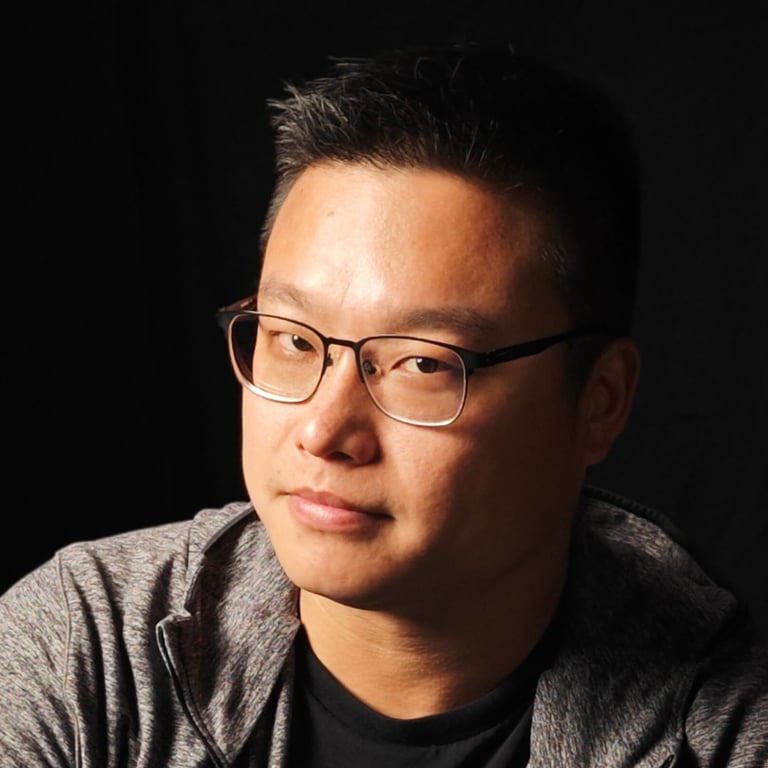
Founded in 2024, Levelup splits its dozen-or-so team members between Shanghai and LA. The category it’s chasing is a familiar one to anyone who’s spent time on the Chinese indie gaming scene over the past few years: pixel art, sims, city-builders, cozy RPGs—the genres that don’t dominate headlines but quietly build some of the most devoted communities on Bilibili, Steam, and Xiaohongshu. Co-founder and CEO Daniel Liu frames Levelup’s job as giving these games “the context, care, and respect” they deserve when they cross borders. It’s a polite way of saying that most cross-border publishing, in either direction, still kind of sucks at this.

Anyone who’s spent time in wuxia-sandbox Discord servers already knows The Scroll of Taiwu. This title by Kunming studio ConchShipGames has been in Early Access for eight years, moved more than three million copies, and built a cult following on the strength of its absurdly deep, generational sect-building systems—the kind of mechanical density that’s very much a guochan (domestically-made) flex, and not an easy sell to Western press used to more legible action-RPG structures.

Levelup didn’t build Taiwu. What it did was translate the game’s cultural density into something Western outlets could actually engage with, resulting in coverage from major game publications like PC Gamer and GamesIndustry.biz. It’s become Levelup’s go-to case study for what “China-to-global” publishing should look like: not sanding down the cultural specificity, but building the bridge so Western audiences don’t need a wiki page open just to appreciate what makes the game special.

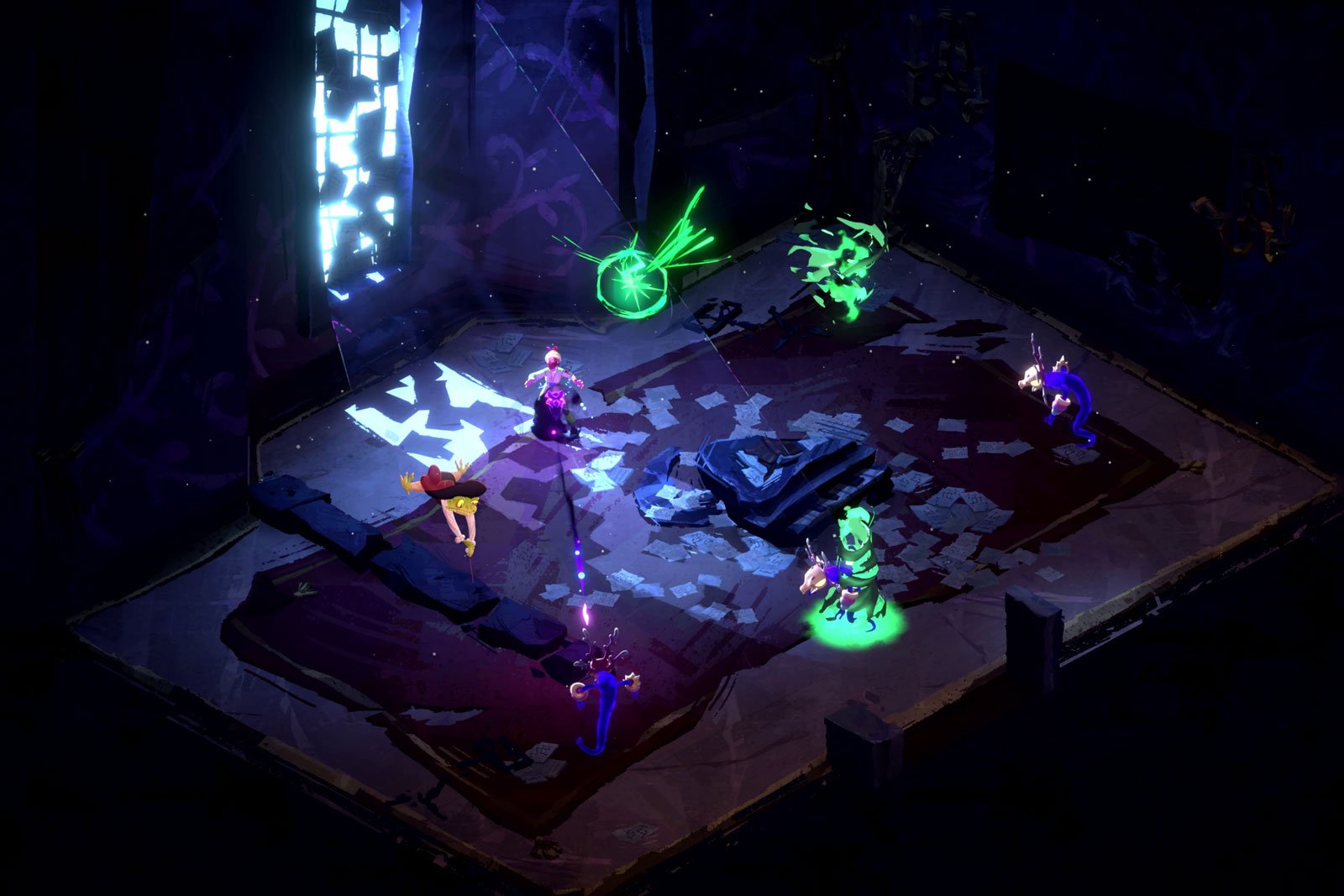
The more interesting move, though, is what happened at Gamescom 2026, when Levelup showed up attached to Murals. It’s the new isometric action game from British studio Dlala Studios of Disney Illusion Island and the Battletoads reboot, with composer David Housden—who scored both those games—back for a full live-orchestra score this time around. Polygon called it “the coolest new action game of Gamescom 2026,” praising a combat loop with real roguelike flavor. Though Dlala is careful to point out Murals is fully linear, not an actual roguelike that’s wrapped around a genuinely unsettling, hand-painted fairy-tale aesthetic. The studio’s own reference point is Who Framed Roger Rabbit, with its hand-painted 2D environments colliding with fully-modeled 3D combat, held together so the seams don’t show. Familiar stories—Sleeping Beauty, Rapunzel, Hansel and Gretel—get turned inside out, with recognizable characters recast as enemies. Basically nothing from your childhood is safe. (The name checks out, too: the hero’s only companion, Loaf, is literally a sketch that’s come to life; a mural that’s wandered off the wall.)

Levelup’s involvement started as a straightforward China-market localization deal and, per CEO Daniel Liu, has since grown into broader APAC publishing support. The stakes here are higher than they might look at first glance: Murals is Dlala’s first wholly original IP in over a decade, and the first title the studio is self-publishing rather than routing through a larger partner. That makes outfits like Levelup, who handles China-region strategy, and Tara Bruno PR, who runs general press, less of a nice-to-have and more like infrastructure Dlala doesn’t yet have in-house. It’s a quieter signal than the Taiwu case, but arguably a more important one: a Chinese company doing inbound cultural translation work—not just outbound. For a studio built on the premise that cross-border publishing shouldn’t just run in one direction, it’s the proof point that matters most.
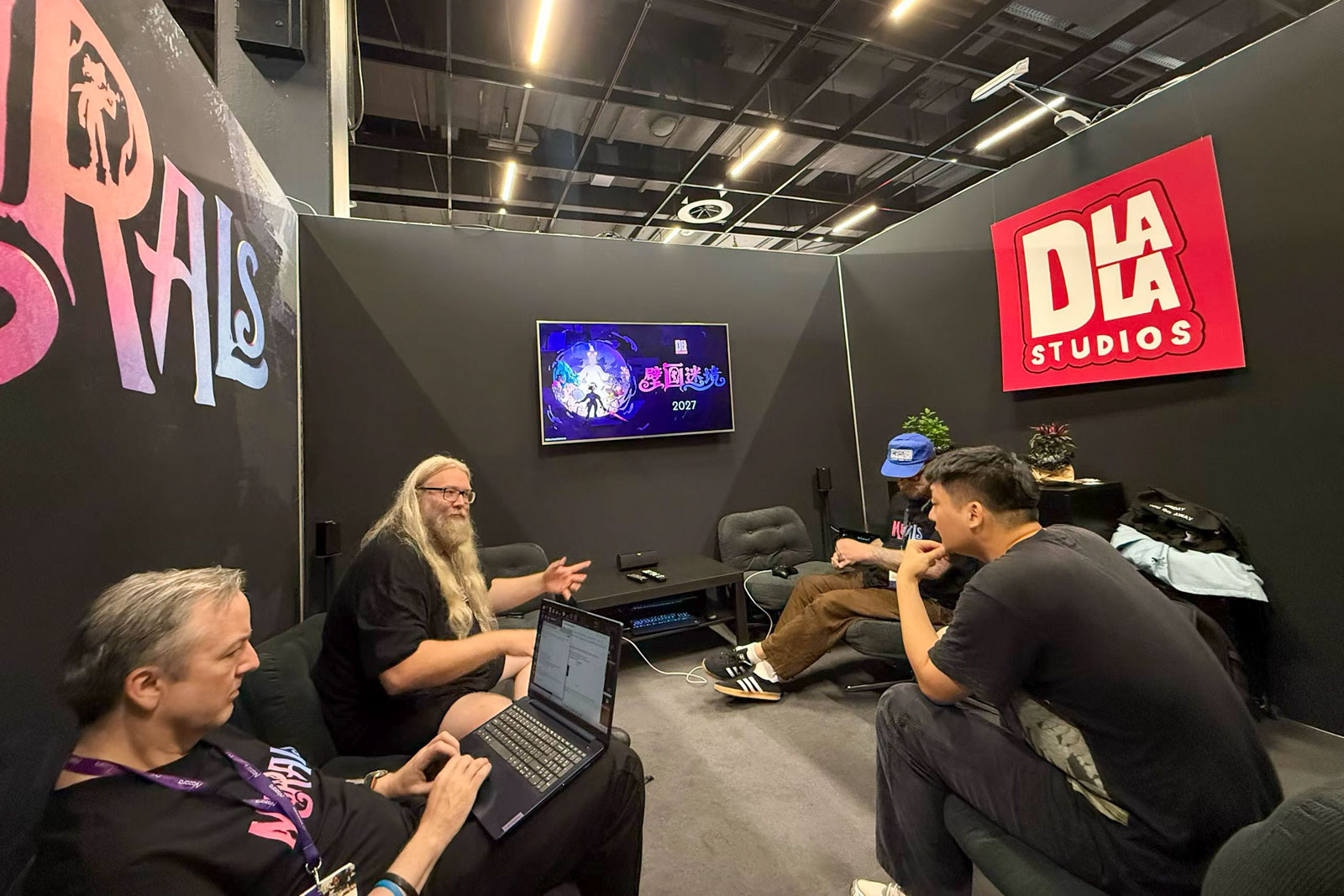
Dlala Studios and LevelUp Games at Gamescom 2026.

The Levelup team itself reads like a deliberate answer to where most publishers screw this up. Co-founder Rupert Zhao spent years as a gaming journalist, which shows in how fluently Levelup talks to press instead of at them. COO Selina Sun’s management-consulting background explains the company’s fondness for phrases like “commercial conversion” in its decks. And then there’s advisor Malcolm Clarke—a four-time Oscar nominee, two-time winner—offering narrative guidance to a slate of pixel-art farm sims and fairytale horror games, which is either a slightly absurd flex or exactly the instinct a cozy-games publisher needs to make sure the vibes hold up under scrutiny.

Liu, for his part, resists being boxed into the “helping foreign games break into China” narrative that a lot of outlets default to. “I wouldn’t frame Levelup purely as a global-to-China play,” he says. Levelup, in his telling, is “a cross-border publishing company that can work effectively in both directions.” His bio leans into the joke a little: an “investor-trained entrepreneur who turned a love for pixel art into a publishing company,” on a mission of “convincing people that cozy games are a legitimate asset class.”
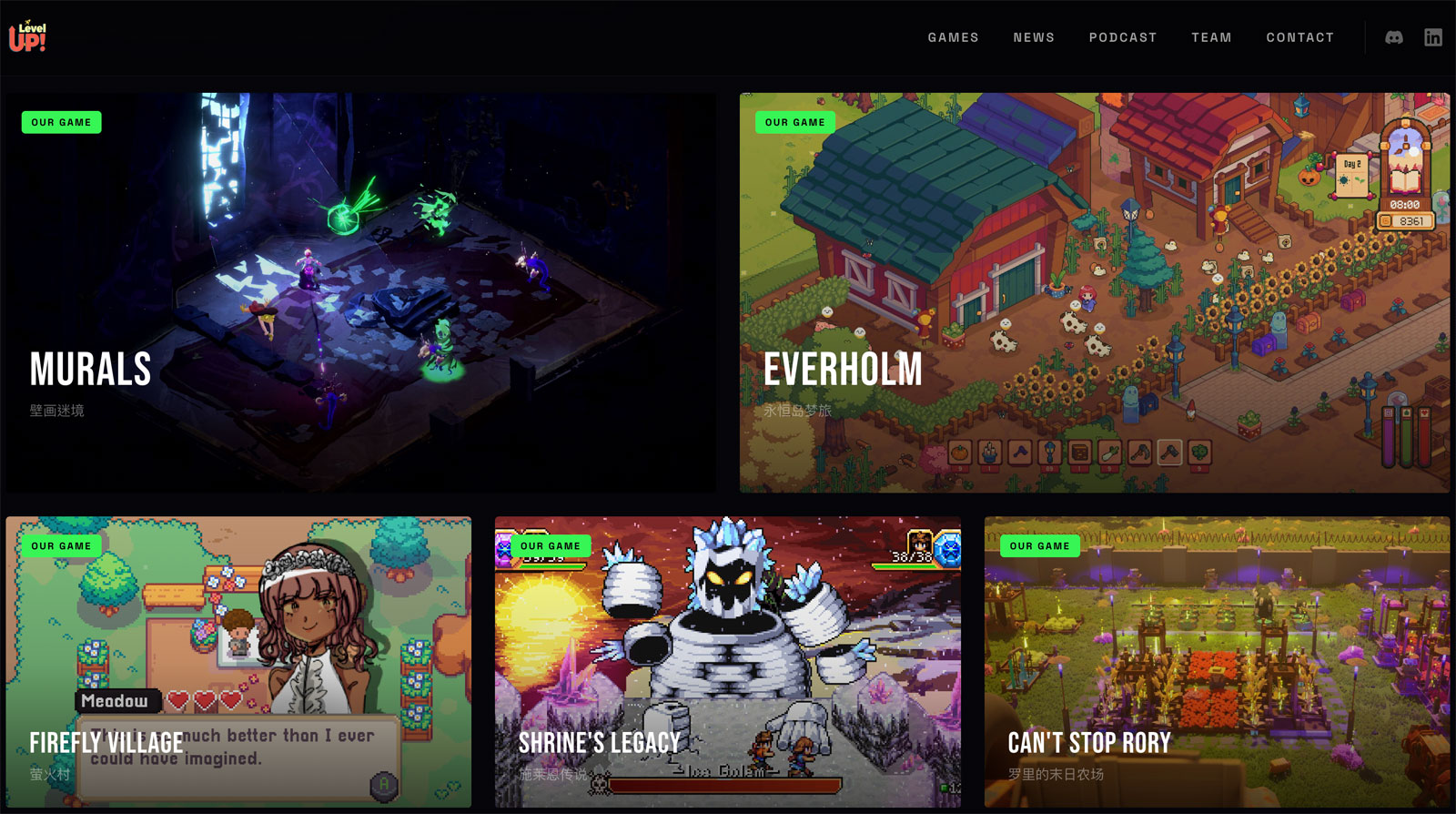
Indeed, cozy games have become one of the most reliable engines of loyal, low-churn player bases anywhere. A genre built for people who are burnt out on live-service treadmills and gacha FOMO—Chinese and Western players alike. Levelup’s current slate—Everholm‘s slow-burn island mystery, Firefly Village‘s pocket-sized farming loop, Shrine’s Legacy‘s 16-bit co-op throwback, Can’t Stop Rory‘s farming-by-day-mecha-by-night hybrid—reads less like a random indie catalogue and more like a coherent bet on where a meaningful slice of the global player base is already heading.

None of this makes Levelup a major player yet. It’s a small team making calculated bets in an industry still figuring out how to talk about Chinese games without either overselling the soft-power narrative or reducing everything to a geopolitics story. But the Taiwu-to-Murals arc, compressed into about eighteen months, says something real about where cross-border publishing could actually go: less about which direction the export flows, and more about whether anyone’s doing the actual work of translation—culturally, not just linguistically—in either direction.

That’s a smaller story than “China’s gaming industry flexes soft power abroad.” It’s also a more useful one.

Images via LevelUp Games.

NEWSLETTER

Get weekly top picks and exclusive, newsletter only content delivered straight to you inbox.

NEWSLETTER

Get weekly top picks and exclusive, newsletter only content delivered straight to you inbox.

RADII NEWSLETTER

Get weekly top picks and exclusive, newsletter only content delivered straight to you inbox

Feature image of Meet the Shanghai Studio Quietly Rewiring How China’s Games Reach the World

Meet the Shanghai Studio Quietly Rewiring How China’s Games Reach the World

5 mins read

Levelup Games isn't a household name yet, but its two biggest bets — a wuxia cult classic and a British fairy-tale horror game — say something real about where cross-border publishing is actually headed.

Tucked into an office on a Shanghai street, a small team is trying to pull off something that’s tripped up companies with far bigger budgets: getting the rest of the world to actually care about Chinese-made games—without the story getting flattened into censorship headlines, “soft power” op-eds, or reductive Tencent comparisons.

Levelup Games hasn’t fully cracked this. Nobody has. But it’s got a burgeoning two-city setup, a clear point of view, and—somewhat improbably—a two-time Oscar-winning filmmaker quietly advising on narrative.

Founded in 2024, Levelup splits its dozen-or-so team members between Shanghai and LA. The category it’s chasing is a familiar one to anyone who’s spent time on the Chinese indie gaming scene over the past few years: pixel art, sims, city-builders, cozy RPGs—the genres that don’t dominate headlines but quietly build some of the most devoted communities on Bilibili, Steam, and Xiaohongshu. Co-founder and CEO Daniel Liu frames Levelup’s job as giving these games “the context, care, and respect” they deserve when they cross borders. It’s a polite way of saying that most cross-border publishing, in either direction, still kind of sucks at this.

Anyone who’s spent time in wuxia-sandbox Discord servers already knows The Scroll of Taiwu. This title by Kunming studio ConchShipGames has been in Early Access for eight years, moved more than three million copies, and built a cult following on the strength of its absurdly deep, generational sect-building systems—the kind of mechanical density that’s very much a guochan (domestically-made) flex, and not an easy sell to Western press used to more legible action-RPG structures.

Levelup didn’t build Taiwu. What it did was translate the game’s cultural density into something Western outlets could actually engage with, resulting in coverage from major game publications like PC Gamer and GamesIndustry.biz. It’s become Levelup’s go-to case study for what “China-to-global” publishing should look like: not sanding down the cultural specificity, but building the bridge so Western audiences don’t need a wiki page open just to appreciate what makes the game special.

The more interesting move, though, is what happened at Gamescom 2026, when Levelup showed up attached to Murals. It’s the new isometric action game from British studio Dlala Studios of Disney Illusion Island and the Battletoads reboot, with composer David Housden—who scored both those games—back for a full live-orchestra score this time around. Polygon called it “the coolest new action game of Gamescom 2026,” praising a combat loop with real roguelike flavor. Though Dlala is careful to point out Murals is fully linear, not an actual roguelike that’s wrapped around a genuinely unsettling, hand-painted fairy-tale aesthetic. The studio’s own reference point is Who Framed Roger Rabbit, with its hand-painted 2D environments colliding with fully-modeled 3D combat, held together so the seams don’t show. Familiar stories—Sleeping Beauty, Rapunzel, Hansel and Gretel—get turned inside out, with recognizable characters recast as enemies. Basically nothing from your childhood is safe. (The name checks out, too: the hero’s only companion, Loaf, is literally a sketch that’s come to life; a mural that’s wandered off the wall.)

Levelup’s involvement started as a straightforward China-market localization deal and, per CEO Daniel Liu, has since grown into broader APAC publishing support. The stakes here are higher than they might look at first glance: Murals is Dlala’s first wholly original IP in over a decade, and the first title the studio is self-publishing rather than routing through a larger partner. That makes outfits like Levelup, who handles China-region strategy, and Tara Bruno PR, who runs general press, less of a nice-to-have and more like infrastructure Dlala doesn’t yet have in-house. It’s a quieter signal than the Taiwu case, but arguably a more important one: a Chinese company doing inbound cultural translation work—not just outbound. For a studio built on the premise that cross-border publishing shouldn’t just run in one direction, it’s the proof point that matters most.

Dlala Studios and LevelUp Games at Gamescom 2026.

The Levelup team itself reads like a deliberate answer to where most publishers screw this up. Co-founder Rupert Zhao spent years as a gaming journalist, which shows in how fluently Levelup talks to press instead of at them. COO Selina Sun’s management-consulting background explains the company’s fondness for phrases like “commercial conversion” in its decks. And then there’s advisor Malcolm Clarke—a four-time Oscar nominee, two-time winner—offering narrative guidance to a slate of pixel-art farm sims and fairytale horror games, which is either a slightly absurd flex or exactly the instinct a cozy-games publisher needs to make sure the vibes hold up under scrutiny.

Liu, for his part, resists being boxed into the “helping foreign games break into China” narrative that a lot of outlets default to. “I wouldn’t frame Levelup purely as a global-to-China play,” he says. Levelup, in his telling, is “a cross-border publishing company that can work effectively in both directions.” His bio leans into the joke a little: an “investor-trained entrepreneur who turned a love for pixel art into a publishing company,” on a mission of “convincing people that cozy games are a legitimate asset class.”

Indeed, cozy games have become one of the most reliable engines of loyal, low-churn player bases anywhere. A genre built for people who are burnt out on live-service treadmills and gacha FOMO—Chinese and Western players alike. Levelup’s current slate—Everholm‘s slow-burn island mystery, Firefly Village‘s pocket-sized farming loop, Shrine’s Legacy‘s 16-bit co-op throwback, Can’t Stop Rory‘s farming-by-day-mecha-by-night hybrid—reads less like a random indie catalogue and more like a coherent bet on where a meaningful slice of the global player base is already heading.

None of this makes Levelup a major player yet. It’s a small team making calculated bets in an industry still figuring out how to talk about Chinese games without either overselling the soft-power narrative or reducing everything to a geopolitics story. But the Taiwu-to-Murals arc, compressed into about eighteen months, says something real about where cross-border publishing could actually go: less about which direction the export flows, and more about whether anyone’s doing the actual work of translation—culturally, not just linguistically—in either direction.

That’s a smaller story than “China’s gaming industry flexes soft power abroad.” It’s also a more useful one.

Images via LevelUp Games.

NEWSLETTER

Get weekly top picks and exclusive, newsletter only content delivered straight to you inbox.

RADII NEWSLETTER

Get weekly top picks and exclusive, newsletter only content delivered straight to you inbox

RELATED POSTS

Feature image of Meet the Shanghai Studio Quietly Rewiring How China’s Games Reach the World

Meet the Shanghai Studio Quietly Rewiring How China’s Games Reach the World

5 mins read

5 mins read

Feature image of Meet the Shanghai Studio Quietly Rewiring How China’s Games Reach the World
Levelup Games isn't a household name yet, but its two biggest bets — a wuxia cult classic and a British fairy-tale horror game — say something real about where cross-border publishing is actually headed.

Tucked into an office on a Shanghai street, a small team is trying to pull off something that’s tripped up companies with far bigger budgets: getting the rest of the world to actually care about Chinese-made games—without the story getting flattened into censorship headlines, “soft power” op-eds, or reductive Tencent comparisons.

Levelup Games hasn’t fully cracked this. Nobody has. But it’s got a burgeoning two-city setup, a clear point of view, and—somewhat improbably—a two-time Oscar-winning filmmaker quietly advising on narrative.

Founded in 2024, Levelup splits its dozen-or-so team members between Shanghai and LA. The category it’s chasing is a familiar one to anyone who’s spent time on the Chinese indie gaming scene over the past few years: pixel art, sims, city-builders, cozy RPGs—the genres that don’t dominate headlines but quietly build some of the most devoted communities on Bilibili, Steam, and Xiaohongshu. Co-founder and CEO Daniel Liu frames Levelup’s job as giving these games “the context, care, and respect” they deserve when they cross borders. It’s a polite way of saying that most cross-border publishing, in either direction, still kind of sucks at this.

Anyone who’s spent time in wuxia-sandbox Discord servers already knows The Scroll of Taiwu. This title by Kunming studio ConchShipGames has been in Early Access for eight years, moved more than three million copies, and built a cult following on the strength of its absurdly deep, generational sect-building systems—the kind of mechanical density that’s very much a guochan (domestically-made) flex, and not an easy sell to Western press used to more legible action-RPG structures.

Levelup didn’t build Taiwu. What it did was translate the game’s cultural density into something Western outlets could actually engage with, resulting in coverage from major game publications like PC Gamer and GamesIndustry.biz. It’s become Levelup’s go-to case study for what “China-to-global” publishing should look like: not sanding down the cultural specificity, but building the bridge so Western audiences don’t need a wiki page open just to appreciate what makes the game special.

The more interesting move, though, is what happened at Gamescom 2026, when Levelup showed up attached to Murals. It’s the new isometric action game from British studio Dlala Studios of Disney Illusion Island and the Battletoads reboot, with composer David Housden—who scored both those games—back for a full live-orchestra score this time around. Polygon called it “the coolest new action game of Gamescom 2026,” praising a combat loop with real roguelike flavor. Though Dlala is careful to point out Murals is fully linear, not an actual roguelike that’s wrapped around a genuinely unsettling, hand-painted fairy-tale aesthetic. The studio’s own reference point is Who Framed Roger Rabbit, with its hand-painted 2D environments colliding with fully-modeled 3D combat, held together so the seams don’t show. Familiar stories—Sleeping Beauty, Rapunzel, Hansel and Gretel—get turned inside out, with recognizable characters recast as enemies. Basically nothing from your childhood is safe. (The name checks out, too: the hero’s only companion, Loaf, is literally a sketch that’s come to life; a mural that’s wandered off the wall.)

Levelup’s involvement started as a straightforward China-market localization deal and, per CEO Daniel Liu, has since grown into broader APAC publishing support. The stakes here are higher than they might look at first glance: Murals is Dlala’s first wholly original IP in over a decade, and the first title the studio is self-publishing rather than routing through a larger partner. That makes outfits like Levelup, who handles China-region strategy, and Tara Bruno PR, who runs general press, less of a nice-to-have and more like infrastructure Dlala doesn’t yet have in-house. It’s a quieter signal than the Taiwu case, but arguably a more important one: a Chinese company doing inbound cultural translation work—not just outbound. For a studio built on the premise that cross-border publishing shouldn’t just run in one direction, it’s the proof point that matters most.

Dlala Studios and LevelUp Games at Gamescom 2026.

The Levelup team itself reads like a deliberate answer to where most publishers screw this up. Co-founder Rupert Zhao spent years as a gaming journalist, which shows in how fluently Levelup talks to press instead of at them. COO Selina Sun’s management-consulting background explains the company’s fondness for phrases like “commercial conversion” in its decks. And then there’s advisor Malcolm Clarke—a four-time Oscar nominee, two-time winner—offering narrative guidance to a slate of pixel-art farm sims and fairytale horror games, which is either a slightly absurd flex or exactly the instinct a cozy-games publisher needs to make sure the vibes hold up under scrutiny.

Liu, for his part, resists being boxed into the “helping foreign games break into China” narrative that a lot of outlets default to. “I wouldn’t frame Levelup purely as a global-to-China play,” he says. Levelup, in his telling, is “a cross-border publishing company that can work effectively in both directions.” His bio leans into the joke a little: an “investor-trained entrepreneur who turned a love for pixel art into a publishing company,” on a mission of “convincing people that cozy games are a legitimate asset class.”

Indeed, cozy games have become one of the most reliable engines of loyal, low-churn player bases anywhere. A genre built for people who are burnt out on live-service treadmills and gacha FOMO—Chinese and Western players alike. Levelup’s current slate—Everholm‘s slow-burn island mystery, Firefly Village‘s pocket-sized farming loop, Shrine’s Legacy‘s 16-bit co-op throwback, Can’t Stop Rory‘s farming-by-day-mecha-by-night hybrid—reads less like a random indie catalogue and more like a coherent bet on where a meaningful slice of the global player base is already heading.

None of this makes Levelup a major player yet. It’s a small team making calculated bets in an industry still figuring out how to talk about Chinese games without either overselling the soft-power narrative or reducing everything to a geopolitics story. But the Taiwu-to-Murals arc, compressed into about eighteen months, says something real about where cross-border publishing could actually go: less about which direction the export flows, and more about whether anyone’s doing the actual work of translation—culturally, not just linguistically—in either direction.

That’s a smaller story than “China’s gaming industry flexes soft power abroad.” It’s also a more useful one.

Images via LevelUp Games.
NEWSLETTER

Get weekly top picks and exclusive, newsletter only content delivered straight to you inbox.

NEWSLETTER

Get weekly top picks and exclusive, newsletter only content delivered straight to you inbox.

RADII NEWSLETTER

Get weekly top picks and exclusive, newsletter only content delivered straight to you inbox

Feature image of Meet the Shanghai Studio Quietly Rewiring How China’s Games Reach the World

Meet the Shanghai Studio Quietly Rewiring How China’s Games Reach the World

5 mins read

Levelup Games isn't a household name yet, but its two biggest bets — a wuxia cult classic and a British fairy-tale horror game — say something real about where cross-border publishing is actually headed.

Tucked into an office on a Shanghai street, a small team is trying to pull off something that’s tripped up companies with far bigger budgets: getting the rest of the world to actually care about Chinese-made games—without the story getting flattened into censorship headlines, “soft power” op-eds, or reductive Tencent comparisons.

Levelup Games hasn’t fully cracked this. Nobody has. But it’s got a burgeoning two-city setup, a clear point of view, and—somewhat improbably—a two-time Oscar-winning filmmaker quietly advising on narrative.

Founded in 2024, Levelup splits its dozen-or-so team members between Shanghai and LA. The category it’s chasing is a familiar one to anyone who’s spent time on the Chinese indie gaming scene over the past few years: pixel art, sims, city-builders, cozy RPGs—the genres that don’t dominate headlines but quietly build some of the most devoted communities on Bilibili, Steam, and Xiaohongshu. Co-founder and CEO Daniel Liu frames Levelup’s job as giving these games “the context, care, and respect” they deserve when they cross borders. It’s a polite way of saying that most cross-border publishing, in either direction, still kind of sucks at this.

Anyone who’s spent time in wuxia-sandbox Discord servers already knows The Scroll of Taiwu. This title by Kunming studio ConchShipGames has been in Early Access for eight years, moved more than three million copies, and built a cult following on the strength of its absurdly deep, generational sect-building systems—the kind of mechanical density that’s very much a guochan (domestically-made) flex, and not an easy sell to Western press used to more legible action-RPG structures.

Levelup didn’t build Taiwu. What it did was translate the game’s cultural density into something Western outlets could actually engage with, resulting in coverage from major game publications like PC Gamer and GamesIndustry.biz. It’s become Levelup’s go-to case study for what “China-to-global” publishing should look like: not sanding down the cultural specificity, but building the bridge so Western audiences don’t need a wiki page open just to appreciate what makes the game special.

The more interesting move, though, is what happened at Gamescom 2026, when Levelup showed up attached to Murals. It’s the new isometric action game from British studio Dlala Studios of Disney Illusion Island and the Battletoads reboot, with composer David Housden—who scored both those games—back for a full live-orchestra score this time around. Polygon called it “the coolest new action game of Gamescom 2026,” praising a combat loop with real roguelike flavor. Though Dlala is careful to point out Murals is fully linear, not an actual roguelike that’s wrapped around a genuinely unsettling, hand-painted fairy-tale aesthetic. The studio’s own reference point is Who Framed Roger Rabbit, with its hand-painted 2D environments colliding with fully-modeled 3D combat, held together so the seams don’t show. Familiar stories—Sleeping Beauty, Rapunzel, Hansel and Gretel—get turned inside out, with recognizable characters recast as enemies. Basically nothing from your childhood is safe. (The name checks out, too: the hero’s only companion, Loaf, is literally a sketch that’s come to life; a mural that’s wandered off the wall.)

Levelup’s involvement started as a straightforward China-market localization deal and, per CEO Daniel Liu, has since grown into broader APAC publishing support. The stakes here are higher than they might look at first glance: Murals is Dlala’s first wholly original IP in over a decade, and the first title the studio is self-publishing rather than routing through a larger partner. That makes outfits like Levelup, who handles China-region strategy, and Tara Bruno PR, who runs general press, less of a nice-to-have and more like infrastructure Dlala doesn’t yet have in-house. It’s a quieter signal than the Taiwu case, but arguably a more important one: a Chinese company doing inbound cultural translation work—not just outbound. For a studio built on the premise that cross-border publishing shouldn’t just run in one direction, it’s the proof point that matters most.

Dlala Studios and LevelUp Games at Gamescom 2026.

The Levelup team itself reads like a deliberate answer to where most publishers screw this up. Co-founder Rupert Zhao spent years as a gaming journalist, which shows in how fluently Levelup talks to press instead of at them. COO Selina Sun’s management-consulting background explains the company’s fondness for phrases like “commercial conversion” in its decks. And then there’s advisor Malcolm Clarke—a four-time Oscar nominee, two-time winner—offering narrative guidance to a slate of pixel-art farm sims and fairytale horror games, which is either a slightly absurd flex or exactly the instinct a cozy-games publisher needs to make sure the vibes hold up under scrutiny.

Liu, for his part, resists being boxed into the “helping foreign games break into China” narrative that a lot of outlets default to. “I wouldn’t frame Levelup purely as a global-to-China play,” he says. Levelup, in his telling, is “a cross-border publishing company that can work effectively in both directions.” His bio leans into the joke a little: an “investor-trained entrepreneur who turned a love for pixel art into a publishing company,” on a mission of “convincing people that cozy games are a legitimate asset class.”

Indeed, cozy games have become one of the most reliable engines of loyal, low-churn player bases anywhere. A genre built for people who are burnt out on live-service treadmills and gacha FOMO—Chinese and Western players alike. Levelup’s current slate—Everholm‘s slow-burn island mystery, Firefly Village‘s pocket-sized farming loop, Shrine’s Legacy‘s 16-bit co-op throwback, Can’t Stop Rory‘s farming-by-day-mecha-by-night hybrid—reads less like a random indie catalogue and more like a coherent bet on where a meaningful slice of the global player base is already heading.

None of this makes Levelup a major player yet. It’s a small team making calculated bets in an industry still figuring out how to talk about Chinese games without either overselling the soft-power narrative or reducing everything to a geopolitics story. But the Taiwu-to-Murals arc, compressed into about eighteen months, says something real about where cross-border publishing could actually go: less about which direction the export flows, and more about whether anyone’s doing the actual work of translation—culturally, not just linguistically—in either direction.

That’s a smaller story than “China’s gaming industry flexes soft power abroad.” It’s also a more useful one.

Images via LevelUp Games.
NEWSLETTER

Get weekly top picks and exclusive, newsletter only content delivered straight to you inbox.

RADII NEWSLETTER

Get weekly top picks and exclusive, newsletter only content delivered straight to you inbox

RADII newsletter pop up visual

NEWSLETTER​

Get weekly top picks and exclusive, newsletter only content delivered straight to you inbox

RADII Newsletter Pop Up small banner

NEWSLETTER

Get weekly top picks and exclusive, newsletter only content delivered straight to you inbox.

Link Copied!

Share

Feature image of Meet the Shanghai Studio Quietly Rewiring How China’s Games Reach the World

Meet the Shanghai Studio Quietly Rewiring How China’s Games Reach the World

Levelup Games isn't a household name yet, but its two biggest bets — a wuxia cult classic and a British fairy-tale horror game — say something real about where cross-border publishing is actually headed.

PULSE

Tap into the latest in music, fashion, art, design, entertainment, pop culture, celebrity news, and contemporary culture

DISCOVER

Embark on a journey through food, travel, wellness, heritage, traditional culture, and lifestyle

STYLE

An insider’s look at the intersection of fashion, art, and design

FEAST

Titillate your taste buds with coverage of the best food and drink trends from China and beyond.

FUTURE

Explore the cutting edge in tech, AI, gadgets, gaming, and innovative tech-related products

FEAST

Titillate your taste buds with coverage of the best food and drink trends from China and beyond

STYLE

An insider’s look at the intersection of fashion, art, and design

PULSE

Unpacking Chinese youth culture through coverage of nightlife, film, sports, celebrities, and the hottest new music