

Feature image of Robots Are Now Fighting for Their Spot in the Sports World

Robots Are Now Fighting for Their Spot in the Sports World

4 mins read

4 mins read

Feature image of Robots Are Now Fighting for Their Spot in the Sports World
RADII has exclusive insight into how CyberHero wants to turn humanoid robots from lab experiments into the next big live sport.

If you thought the future of sports was going to involve humans getting faster, stronger, and more genetically optimized, think again. Just yesterday in Riyadh—Saudi Arabia’s capital—the athletes were made of full metal.

RADII highlights Hero esports' CyberHero robot fighting league in Riyadh, Saudi Arabia.

CyberHero, billed as the world’s first global humanoid robot sports league, officially launched in the vibrant city with a spectacle that looked like someone had mashed together a boxing match, an esports tournament, and a sci-fi movie (think Hugh Jackman’s Real Steel)—then given the whole thing a giant entertainment budget.

RADII highlights Hero esports' CyberHero robot fighting league in Riyadh, Saudi Arabia.
Scene from Real Steel (2011), back when fighting humanoid robots was a mere sci-fi fantasy. Image via YouTube/Prime Recap.

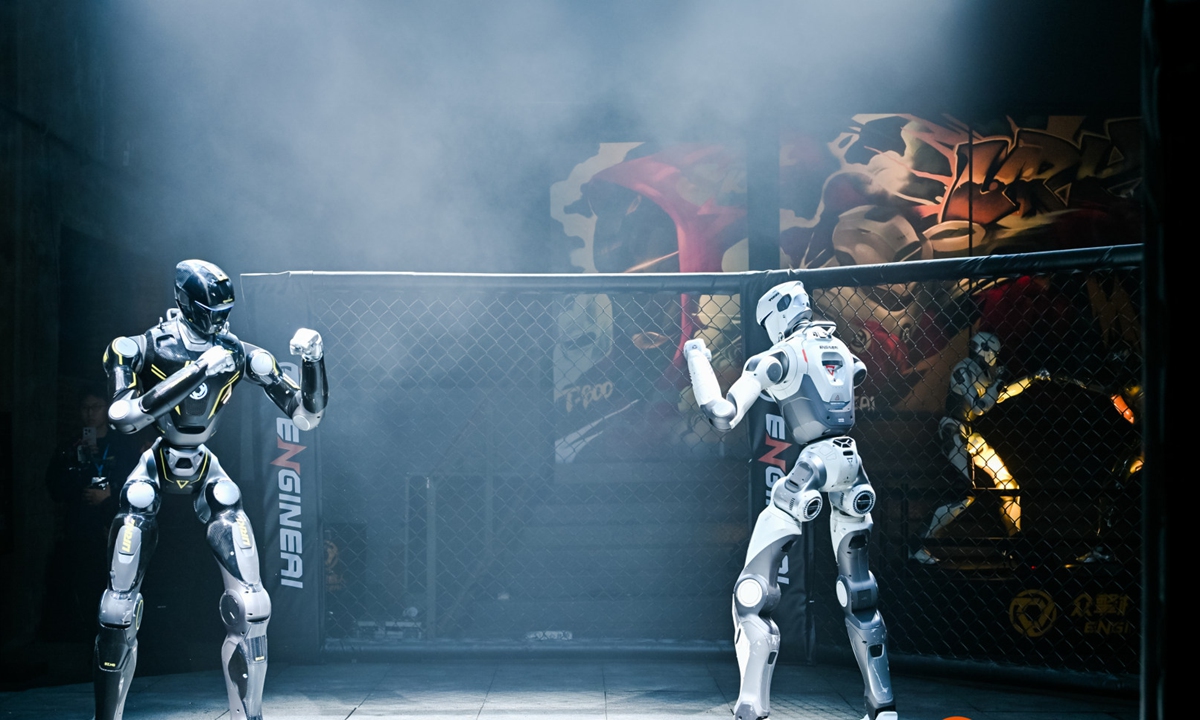
The event featured EngineAI T800 humanoid robots going head-to-head inside a purpose-built arena, marking the Middle East’s first humanoid robot combat event. Roughly 1.73 meters tall and weighing between 75 and 85 kilograms, the T800s are about human-sized, except they come equipped with 29 articulated joints and the ability to walk, run, punch, kick, turn, and recover after taking a beating (or tumble). Apparently, they can dance, too (but so can we… Big whoop).

RADII highlights Hero esports' CyberHero robot fighting league in Riyadh, Saudi Arabia.

Behind the new league and sci-fi-turned-reality spectacle is Hero Esports, one of Asia’s biggest esports operators, which organizes more than 7,000 esports competitions annually that reach more than 800 million fans worldwide. If you’re unfamiliar with the company, you’ll most likely have heard of some of its major titles, including Honor of Kings, Peacekeeper Elite, League of Legends, and VALORANT, as well as its role as a China partner of the Esports World Cup. Now it is betting that the next arena for competitive entertainment might not be digital at all.

RADII highlights Hero esports' CyberHero robot fighting league in Riyadh, Saudi Arabia.
Hero Esports is the primary partner and tournament organizer of Riot Games’ Valorant, a character-based tactical FPS. Image via HS Insider.

The plan is ambitious: eight CyberHero stops across four regions—the Middle East, Europe, the Americas, and Asia. Rather than keeping robots behind glass in research labs, Hero Esports wants to put them under bright lights, in front of crowds, and see what happens when competition becomes part of the development process.

“CyberHero was born from a bold idea about the future of competition: that robots can be pushed to test their limits, break new boundaries, and improve through data generated in competition,” said Danny Tang, Co-founder and CEO of Hero Esports.

RADII highlights Hero esports' CyberHero robot fighting league in Riyadh, Saudi Arabia.
A flashy flying kick from one of the T800 robots.

“That is one of the lessons we have learned from esports, and it is also a responsibility we see for Hero Esports over the next decade—to use competition to drive innovation and progress. We are now establishing a global technology lab at our Shanghai headquarters to bring together technical expertise and talent from around the world.”

That last part is important. The fighting is basically the flashy bit.

RADII highlights Hero esports' CyberHero robot fighting league in Riyadh, Saudi Arabia.

CyberHero’s competition is built around three roles: builders, who design and engineer the robots (brings to mind Big Hero 6); coders, who develop and train the software that controls their intelligence; and drivers, who make live decisions during competition. Think BattleBots but swap out Roombas with spin blades for Power Ranger-looking humanoids.

RADII highlights Hero esports' CyberHero robot fighting league in Riyadh, Saudi Arabia.
Fighting “Doombas.” Image via BattleBot Wiki.

The concept also taps into one of the biggest shifts happening in robotics right now: “physical AI.” In simple terms, that means AI that doesn’t just generate text or images on a screen, but can perceive and act in the real world through a physical body. The better these systems become at balancing, navigating, reacting, and learning, the less humanoid robots look like fancy prototypes and the more they start looking like actual machines with jobs to do.

China has been particularly aggressive in turning that idea into public spectacle. Earlier this year, Shenzhen hosted the launch of URKL, a commercial humanoid robot fighting league using the same EngineAI T800 platform. And at Beijing’s 2026 World Humanoid Robot Games, robot athletes competed in everything from sprinting to jumping—with some machines even threatening human athletic records.

RADII highlights Hero esports' CyberHero robot fighting league in Riyadh, Saudi Arabia.

RADII has been following this weird, fascinating transition for a while. In our recent piece “Faster Than Usain Bolt? Why China’s Running Robots Mean Plan B is Canceled,” we looked at what happens when humanoid machines start challenging the physical limits we once considered exclusively human.

We’ve also asked whether robot combat is actually the best use of all this rapidly developing technology in “Are Fighting Robots the Future? Inside the World’s First URKL Combat.”

RADII highlights Hero esports' CyberHero robot fighting league in Riyadh, Saudi Arabia.

The question is becoming harder to avoid. What happens when robots stop being demonstrations and start becoming competitors?

At CyberHero x Riyadh, the answer was wrapped in lasers, music, and influencer culture. MENA creator AboFlah and Saudi sports creator Bashar Arabi served as team managers, while electronic producer and DJ Tokyo Machine supplied the soundtrack. The result was deliberately closer to a gaming event than a robotics conference—because if humanoid robots are going to become a new form of entertainment, they’ll need fandom, personalities, and a little bit of chaos along with their algorithms.

For now, the machines are still very much machines. They (hilaruously) fall over or go completely unhinged. They need batteries. They require teams of humans to build, program, and operate them. And unlike the athletes they’re trying to replace, they don’t get to complain about bad refereeing.

RADII highlights Hero esports' CyberHero robot fighting league in Riyadh, Saudi Arabia.

But that may be precisely the point.

Sport has always been a way of testing what bodies can do. CyberHero is proposing a slightly stranger question: what can an artificial body learn to do when we give it a stadium, an equal rival, and a reason to win?

Riyadh may have just given us the first glimpse.

All images via Hero Esports unless stated otherwise.

NEWSLETTER

Get weekly top picks and exclusive, newsletter only content delivered straight to you inbox.

NEWSLETTER

Get weekly top picks and exclusive, newsletter only content delivered straight to you inbox.

RADII NEWSLETTER

Get weekly top picks and exclusive, newsletter only content delivered straight to you inbox

Feature image of Robots Are Now Fighting for Their Spot in the Sports World

Robots Are Now Fighting for Their Spot in the Sports World

4 mins read

RADII has exclusive insight into how CyberHero wants to turn humanoid robots from lab experiments into the next big live sport.

If you thought the future of sports was going to involve humans getting faster, stronger, and more genetically optimized, think again. Just yesterday in Riyadh—Saudi Arabia’s capital—the athletes were made of full metal.

RADII highlights Hero esports' CyberHero robot fighting league in Riyadh, Saudi Arabia.

CyberHero, billed as the world’s first global humanoid robot sports league, officially launched in the vibrant city with a spectacle that looked like someone had mashed together a boxing match, an esports tournament, and a sci-fi movie (think Hugh Jackman’s Real Steel)—then given the whole thing a giant entertainment budget.

RADII highlights Hero esports' CyberHero robot fighting league in Riyadh, Saudi Arabia.
Scene from Real Steel (2011), back when fighting humanoid robots was a mere sci-fi fantasy. Image via YouTube/Prime Recap.

The event featured EngineAI T800 humanoid robots going head-to-head inside a purpose-built arena, marking the Middle East’s first humanoid robot combat event. Roughly 1.73 meters tall and weighing between 75 and 85 kilograms, the T800s are about human-sized, except they come equipped with 29 articulated joints and the ability to walk, run, punch, kick, turn, and recover after taking a beating (or tumble). Apparently, they can dance, too (but so can we… Big whoop).

RADII highlights Hero esports' CyberHero robot fighting league in Riyadh, Saudi Arabia.

Behind the new league and sci-fi-turned-reality spectacle is Hero Esports, one of Asia’s biggest esports operators, which organizes more than 7,000 esports competitions annually that reach more than 800 million fans worldwide. If you’re unfamiliar with the company, you’ll most likely have heard of some of its major titles, including Honor of Kings, Peacekeeper Elite, League of Legends, and VALORANT, as well as its role as a China partner of the Esports World Cup. Now it is betting that the next arena for competitive entertainment might not be digital at all.

RADII highlights Hero esports' CyberHero robot fighting league in Riyadh, Saudi Arabia.
Hero Esports is the primary partner and tournament organizer of Riot Games’ Valorant, a character-based tactical FPS. Image via HS Insider.

The plan is ambitious: eight CyberHero stops across four regions—the Middle East, Europe, the Americas, and Asia. Rather than keeping robots behind glass in research labs, Hero Esports wants to put them under bright lights, in front of crowds, and see what happens when competition becomes part of the development process.

“CyberHero was born from a bold idea about the future of competition: that robots can be pushed to test their limits, break new boundaries, and improve through data generated in competition,” said Danny Tang, Co-founder and CEO of Hero Esports.

RADII highlights Hero esports' CyberHero robot fighting league in Riyadh, Saudi Arabia.
A flashy flying kick from one of the T800 robots.

“That is one of the lessons we have learned from esports, and it is also a responsibility we see for Hero Esports over the next decade—to use competition to drive innovation and progress. We are now establishing a global technology lab at our Shanghai headquarters to bring together technical expertise and talent from around the world.”

That last part is important. The fighting is basically the flashy bit.

RADII highlights Hero esports' CyberHero robot fighting league in Riyadh, Saudi Arabia.

CyberHero’s competition is built around three roles: builders, who design and engineer the robots (brings to mind Big Hero 6); coders, who develop and train the software that controls their intelligence; and drivers, who make live decisions during competition. Think BattleBots but swap out Roombas with spin blades for Power Ranger-looking humanoids.

RADII highlights Hero esports' CyberHero robot fighting league in Riyadh, Saudi Arabia.
Fighting “Doombas.” Image via BattleBot Wiki.

The concept also taps into one of the biggest shifts happening in robotics right now: “physical AI.” In simple terms, that means AI that doesn’t just generate text or images on a screen, but can perceive and act in the real world through a physical body. The better these systems become at balancing, navigating, reacting, and learning, the less humanoid robots look like fancy prototypes and the more they start looking like actual machines with jobs to do.

China has been particularly aggressive in turning that idea into public spectacle. Earlier this year, Shenzhen hosted the launch of URKL, a commercial humanoid robot fighting league using the same EngineAI T800 platform. And at Beijing’s 2026 World Humanoid Robot Games, robot athletes competed in everything from sprinting to jumping—with some machines even threatening human athletic records.

RADII highlights Hero esports' CyberHero robot fighting league in Riyadh, Saudi Arabia.

RADII has been following this weird, fascinating transition for a while. In our recent piece “Faster Than Usain Bolt? Why China’s Running Robots Mean Plan B is Canceled,” we looked at what happens when humanoid machines start challenging the physical limits we once considered exclusively human.

We’ve also asked whether robot combat is actually the best use of all this rapidly developing technology in “Are Fighting Robots the Future? Inside the World’s First URKL Combat.”

RADII highlights Hero esports' CyberHero robot fighting league in Riyadh, Saudi Arabia.

The question is becoming harder to avoid. What happens when robots stop being demonstrations and start becoming competitors?

At CyberHero x Riyadh, the answer was wrapped in lasers, music, and influencer culture. MENA creator AboFlah and Saudi sports creator Bashar Arabi served as team managers, while electronic producer and DJ Tokyo Machine supplied the soundtrack. The result was deliberately closer to a gaming event than a robotics conference—because if humanoid robots are going to become a new form of entertainment, they’ll need fandom, personalities, and a little bit of chaos along with their algorithms.

For now, the machines are still very much machines. They (hilaruously) fall over or go completely unhinged. They need batteries. They require teams of humans to build, program, and operate them. And unlike the athletes they’re trying to replace, they don’t get to complain about bad refereeing.

RADII highlights Hero esports' CyberHero robot fighting league in Riyadh, Saudi Arabia.

But that may be precisely the point.

Sport has always been a way of testing what bodies can do. CyberHero is proposing a slightly stranger question: what can an artificial body learn to do when we give it a stadium, an equal rival, and a reason to win?

Riyadh may have just given us the first glimpse.

All images via Hero Esports unless stated otherwise.
NEWSLETTER

Get weekly top picks and exclusive, newsletter only content delivered straight to you inbox.

RADII NEWSLETTER

Get weekly top picks and exclusive, newsletter only content delivered straight to you inbox

RELATED POSTS

Feature image of Robots Are Now Fighting for Their Spot in the Sports World

Robots Are Now Fighting for Their Spot in the Sports World

4 mins read

4 mins read

Feature image of Robots Are Now Fighting for Their Spot in the Sports World
RADII has exclusive insight into how CyberHero wants to turn humanoid robots from lab experiments into the next big live sport.

If you thought the future of sports was going to involve humans getting faster, stronger, and more genetically optimized, think again. Just yesterday in Riyadh—Saudi Arabia’s capital—the athletes were made of full metal.

RADII highlights Hero esports' CyberHero robot fighting league in Riyadh, Saudi Arabia.

CyberHero, billed as the world’s first global humanoid robot sports league, officially launched in the vibrant city with a spectacle that looked like someone had mashed together a boxing match, an esports tournament, and a sci-fi movie (think Hugh Jackman’s Real Steel)—then given the whole thing a giant entertainment budget.

RADII highlights Hero esports' CyberHero robot fighting league in Riyadh, Saudi Arabia.
Scene from Real Steel (2011), back when fighting humanoid robots was a mere sci-fi fantasy. Image via YouTube/Prime Recap.

The event featured EngineAI T800 humanoid robots going head-to-head inside a purpose-built arena, marking the Middle East’s first humanoid robot combat event. Roughly 1.73 meters tall and weighing between 75 and 85 kilograms, the T800s are about human-sized, except they come equipped with 29 articulated joints and the ability to walk, run, punch, kick, turn, and recover after taking a beating (or tumble). Apparently, they can dance, too (but so can we… Big whoop).

RADII highlights Hero esports' CyberHero robot fighting league in Riyadh, Saudi Arabia.

Behind the new league and sci-fi-turned-reality spectacle is Hero Esports, one of Asia’s biggest esports operators, which organizes more than 7,000 esports competitions annually that reach more than 800 million fans worldwide. If you’re unfamiliar with the company, you’ll most likely have heard of some of its major titles, including Honor of Kings, Peacekeeper Elite, League of Legends, and VALORANT, as well as its role as a China partner of the Esports World Cup. Now it is betting that the next arena for competitive entertainment might not be digital at all.

RADII highlights Hero esports' CyberHero robot fighting league in Riyadh, Saudi Arabia.
Hero Esports is the primary partner and tournament organizer of Riot Games’ Valorant, a character-based tactical FPS. Image via HS Insider.

The plan is ambitious: eight CyberHero stops across four regions—the Middle East, Europe, the Americas, and Asia. Rather than keeping robots behind glass in research labs, Hero Esports wants to put them under bright lights, in front of crowds, and see what happens when competition becomes part of the development process.

“CyberHero was born from a bold idea about the future of competition: that robots can be pushed to test their limits, break new boundaries, and improve through data generated in competition,” said Danny Tang, Co-founder and CEO of Hero Esports.

RADII highlights Hero esports' CyberHero robot fighting league in Riyadh, Saudi Arabia.
A flashy flying kick from one of the T800 robots.

“That is one of the lessons we have learned from esports, and it is also a responsibility we see for Hero Esports over the next decade—to use competition to drive innovation and progress. We are now establishing a global technology lab at our Shanghai headquarters to bring together technical expertise and talent from around the world.”

That last part is important. The fighting is basically the flashy bit.

RADII highlights Hero esports' CyberHero robot fighting league in Riyadh, Saudi Arabia.

CyberHero’s competition is built around three roles: builders, who design and engineer the robots (brings to mind Big Hero 6); coders, who develop and train the software that controls their intelligence; and drivers, who make live decisions during competition. Think BattleBots but swap out Roombas with spin blades for Power Ranger-looking humanoids.

RADII highlights Hero esports' CyberHero robot fighting league in Riyadh, Saudi Arabia.
Fighting “Doombas.” Image via BattleBot Wiki.

The concept also taps into one of the biggest shifts happening in robotics right now: “physical AI.” In simple terms, that means AI that doesn’t just generate text or images on a screen, but can perceive and act in the real world through a physical body. The better these systems become at balancing, navigating, reacting, and learning, the less humanoid robots look like fancy prototypes and the more they start looking like actual machines with jobs to do.

China has been particularly aggressive in turning that idea into public spectacle. Earlier this year, Shenzhen hosted the launch of URKL, a commercial humanoid robot fighting league using the same EngineAI T800 platform. And at Beijing’s 2026 World Humanoid Robot Games, robot athletes competed in everything from sprinting to jumping—with some machines even threatening human athletic records.

RADII highlights Hero esports' CyberHero robot fighting league in Riyadh, Saudi Arabia.

RADII has been following this weird, fascinating transition for a while. In our recent piece “Faster Than Usain Bolt? Why China’s Running Robots Mean Plan B is Canceled,” we looked at what happens when humanoid machines start challenging the physical limits we once considered exclusively human.

We’ve also asked whether robot combat is actually the best use of all this rapidly developing technology in “Are Fighting Robots the Future? Inside the World’s First URKL Combat.”

RADII highlights Hero esports' CyberHero robot fighting league in Riyadh, Saudi Arabia.

The question is becoming harder to avoid. What happens when robots stop being demonstrations and start becoming competitors?

At CyberHero x Riyadh, the answer was wrapped in lasers, music, and influencer culture. MENA creator AboFlah and Saudi sports creator Bashar Arabi served as team managers, while electronic producer and DJ Tokyo Machine supplied the soundtrack. The result was deliberately closer to a gaming event than a robotics conference—because if humanoid robots are going to become a new form of entertainment, they’ll need fandom, personalities, and a little bit of chaos along with their algorithms.

For now, the machines are still very much machines. They (hilaruously) fall over or go completely unhinged. They need batteries. They require teams of humans to build, program, and operate them. And unlike the athletes they’re trying to replace, they don’t get to complain about bad refereeing.

RADII highlights Hero esports' CyberHero robot fighting league in Riyadh, Saudi Arabia.

But that may be precisely the point.

Sport has always been a way of testing what bodies can do. CyberHero is proposing a slightly stranger question: what can an artificial body learn to do when we give it a stadium, an equal rival, and a reason to win?

Riyadh may have just given us the first glimpse.

All images via Hero Esports unless stated otherwise.

NEWSLETTER

Get weekly top picks and exclusive, newsletter only content delivered straight to you inbox.

NEWSLETTER

Get weekly top picks and exclusive, newsletter only content delivered straight to you inbox.

RADII NEWSLETTER

Get weekly top picks and exclusive, newsletter only content delivered straight to you inbox

Feature image of Robots Are Now Fighting for Their Spot in the Sports World

Robots Are Now Fighting for Their Spot in the Sports World

4 mins read

RADII has exclusive insight into how CyberHero wants to turn humanoid robots from lab experiments into the next big live sport.

If you thought the future of sports was going to involve humans getting faster, stronger, and more genetically optimized, think again. Just yesterday in Riyadh—Saudi Arabia’s capital—the athletes were made of full metal.

RADII highlights Hero esports' CyberHero robot fighting league in Riyadh, Saudi Arabia.

CyberHero, billed as the world’s first global humanoid robot sports league, officially launched in the vibrant city with a spectacle that looked like someone had mashed together a boxing match, an esports tournament, and a sci-fi movie (think Hugh Jackman’s Real Steel)—then given the whole thing a giant entertainment budget.

RADII highlights Hero esports' CyberHero robot fighting league in Riyadh, Saudi Arabia.
Scene from Real Steel (2011), back when fighting humanoid robots was a mere sci-fi fantasy. Image via YouTube/Prime Recap.

The event featured EngineAI T800 humanoid robots going head-to-head inside a purpose-built arena, marking the Middle East’s first humanoid robot combat event. Roughly 1.73 meters tall and weighing between 75 and 85 kilograms, the T800s are about human-sized, except they come equipped with 29 articulated joints and the ability to walk, run, punch, kick, turn, and recover after taking a beating (or tumble). Apparently, they can dance, too (but so can we… Big whoop).

RADII highlights Hero esports' CyberHero robot fighting league in Riyadh, Saudi Arabia.

Behind the new league and sci-fi-turned-reality spectacle is Hero Esports, one of Asia’s biggest esports operators, which organizes more than 7,000 esports competitions annually that reach more than 800 million fans worldwide. If you’re unfamiliar with the company, you’ll most likely have heard of some of its major titles, including Honor of Kings, Peacekeeper Elite, League of Legends, and VALORANT, as well as its role as a China partner of the Esports World Cup. Now it is betting that the next arena for competitive entertainment might not be digital at all.

RADII highlights Hero esports' CyberHero robot fighting league in Riyadh, Saudi Arabia.
Hero Esports is the primary partner and tournament organizer of Riot Games’ Valorant, a character-based tactical FPS. Image via HS Insider.

The plan is ambitious: eight CyberHero stops across four regions—the Middle East, Europe, the Americas, and Asia. Rather than keeping robots behind glass in research labs, Hero Esports wants to put them under bright lights, in front of crowds, and see what happens when competition becomes part of the development process.

“CyberHero was born from a bold idea about the future of competition: that robots can be pushed to test their limits, break new boundaries, and improve through data generated in competition,” said Danny Tang, Co-founder and CEO of Hero Esports.

RADII highlights Hero esports' CyberHero robot fighting league in Riyadh, Saudi Arabia.
A flashy flying kick from one of the T800 robots.

“That is one of the lessons we have learned from esports, and it is also a responsibility we see for Hero Esports over the next decade—to use competition to drive innovation and progress. We are now establishing a global technology lab at our Shanghai headquarters to bring together technical expertise and talent from around the world.”

That last part is important. The fighting is basically the flashy bit.

RADII highlights Hero esports' CyberHero robot fighting league in Riyadh, Saudi Arabia.

CyberHero’s competition is built around three roles: builders, who design and engineer the robots (brings to mind Big Hero 6); coders, who develop and train the software that controls their intelligence; and drivers, who make live decisions during competition. Think BattleBots but swap out Roombas with spin blades for Power Ranger-looking humanoids.

RADII highlights Hero esports' CyberHero robot fighting league in Riyadh, Saudi Arabia.
Fighting “Doombas.” Image via BattleBot Wiki.

The concept also taps into one of the biggest shifts happening in robotics right now: “physical AI.” In simple terms, that means AI that doesn’t just generate text or images on a screen, but can perceive and act in the real world through a physical body. The better these systems become at balancing, navigating, reacting, and learning, the less humanoid robots look like fancy prototypes and the more they start looking like actual machines with jobs to do.

China has been particularly aggressive in turning that idea into public spectacle. Earlier this year, Shenzhen hosted the launch of URKL, a commercial humanoid robot fighting league using the same EngineAI T800 platform. And at Beijing’s 2026 World Humanoid Robot Games, robot athletes competed in everything from sprinting to jumping—with some machines even threatening human athletic records.

RADII highlights Hero esports' CyberHero robot fighting league in Riyadh, Saudi Arabia.

RADII has been following this weird, fascinating transition for a while. In our recent piece “Faster Than Usain Bolt? Why China’s Running Robots Mean Plan B is Canceled,” we looked at what happens when humanoid machines start challenging the physical limits we once considered exclusively human.

We’ve also asked whether robot combat is actually the best use of all this rapidly developing technology in “Are Fighting Robots the Future? Inside the World’s First URKL Combat.”

RADII highlights Hero esports' CyberHero robot fighting league in Riyadh, Saudi Arabia.

The question is becoming harder to avoid. What happens when robots stop being demonstrations and start becoming competitors?

At CyberHero x Riyadh, the answer was wrapped in lasers, music, and influencer culture. MENA creator AboFlah and Saudi sports creator Bashar Arabi served as team managers, while electronic producer and DJ Tokyo Machine supplied the soundtrack. The result was deliberately closer to a gaming event than a robotics conference—because if humanoid robots are going to become a new form of entertainment, they’ll need fandom, personalities, and a little bit of chaos along with their algorithms.

For now, the machines are still very much machines. They (hilaruously) fall over or go completely unhinged. They need batteries. They require teams of humans to build, program, and operate them. And unlike the athletes they’re trying to replace, they don’t get to complain about bad refereeing.

RADII highlights Hero esports' CyberHero robot fighting league in Riyadh, Saudi Arabia.

But that may be precisely the point.

Sport has always been a way of testing what bodies can do. CyberHero is proposing a slightly stranger question: what can an artificial body learn to do when we give it a stadium, an equal rival, and a reason to win?

Riyadh may have just given us the first glimpse.

All images via Hero Esports unless stated otherwise.
NEWSLETTER

Get weekly top picks and exclusive, newsletter only content delivered straight to you inbox.

RADII NEWSLETTER

Get weekly top picks and exclusive, newsletter only content delivered straight to you inbox

RADII newsletter pop up visual

NEWSLETTER​

Get weekly top picks and exclusive, newsletter only content delivered straight to you inbox

RADII Newsletter Pop Up small banner

NEWSLETTER

Get weekly top picks and exclusive, newsletter only content delivered straight to you inbox.

Link Copied!

Share

Feature image of Robots Are Now Fighting for Their Spot in the Sports World

Robots Are Now Fighting for Their Spot in the Sports World

RADII has exclusive insight into how CyberHero wants to turn humanoid robots from lab experiments into the next big live sport.

PULSE

Tap into the latest in music, fashion, art, design, entertainment, pop culture, celebrity news, and contemporary culture

DISCOVER

Embark on a journey through food, travel, wellness, heritage, traditional culture, and lifestyle

STYLE

An insider’s look at the intersection of fashion, art, and design

FEAST

Titillate your taste buds with coverage of the best food and drink trends from China and beyond.

FUTURE

Explore the cutting edge in tech, AI, gadgets, gaming, and innovative tech-related products

FEAST

Titillate your taste buds with coverage of the best food and drink trends from China and beyond

STYLE

An insider’s look at the intersection of fashion, art, and design

PULSE

Unpacking Chinese youth culture through coverage of nightlife, film, sports, celebrities, and the hottest new music