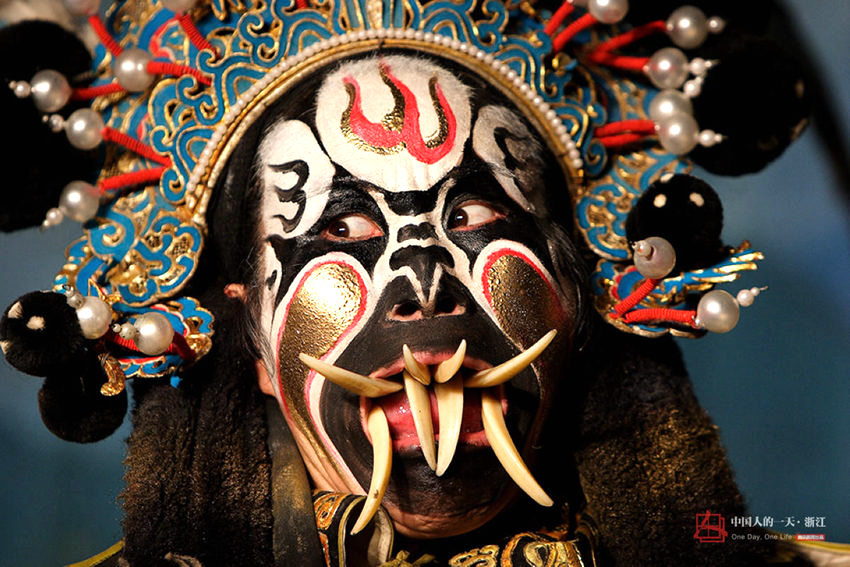


Feature image of Swipe Right for Fluency: Is Dating in China Just a Free English Lesson?

Swipe Right for Fluency: Is Dating in China Just a Free English Lesson?

6 mins read

6 mins read

Feature image of Swipe Right for Fluency: Is Dating in China Just a Free English Lesson?
From taking dates as IELTS speaking tests to "study-buddying" with ABCs, Gen Z girls are hacking the language of intimacy. But in this game of love and linguistics, who is playing whom?

It’s a Friday night on Peel Street, the pulsating aorta of Hong Kong’s nightlife. I am squeezed between a loud Italian man and a British woman, nodding now and then as they dissect their dating disasters.

To an outsider, I look engaged. Inside, my brain is buffering. I only catch 30% of what they are saying, smiling vacantly like an NPC in a video game.

But I’m not just here for the beer. I, like many Gen Z girls from the mainland living in this Tower of Babel, am wondering: am I looking for love? Or am I just subconsciously trying to “level up” my cosmopolitan vibe?

Across China’s first-tier cities, dating apps like Tinder and Bumble seem to have morphed into something else: Duolingo Pro, but with better cocktails and higher emotional stakes.

Here is what happens when the quest for romance collides with the quest for proficiency.

Level 1: The Panic of the “Oral Exam”

For Mia, a master’s student in Hong Kong, the first boss battle was a white expat she met at a networking event. He was polite, professional—the perfect “native speaker” practice partner.

But when they sat down for a one-on-one dinner, the romance evaporated.

“I couldn’t bear this awkward silence,” Mia confesses. “Then he asked me, ‘How does life in Hong Kong compare to your expectations?’ It sounded exactly like an examiner’s prompt.”
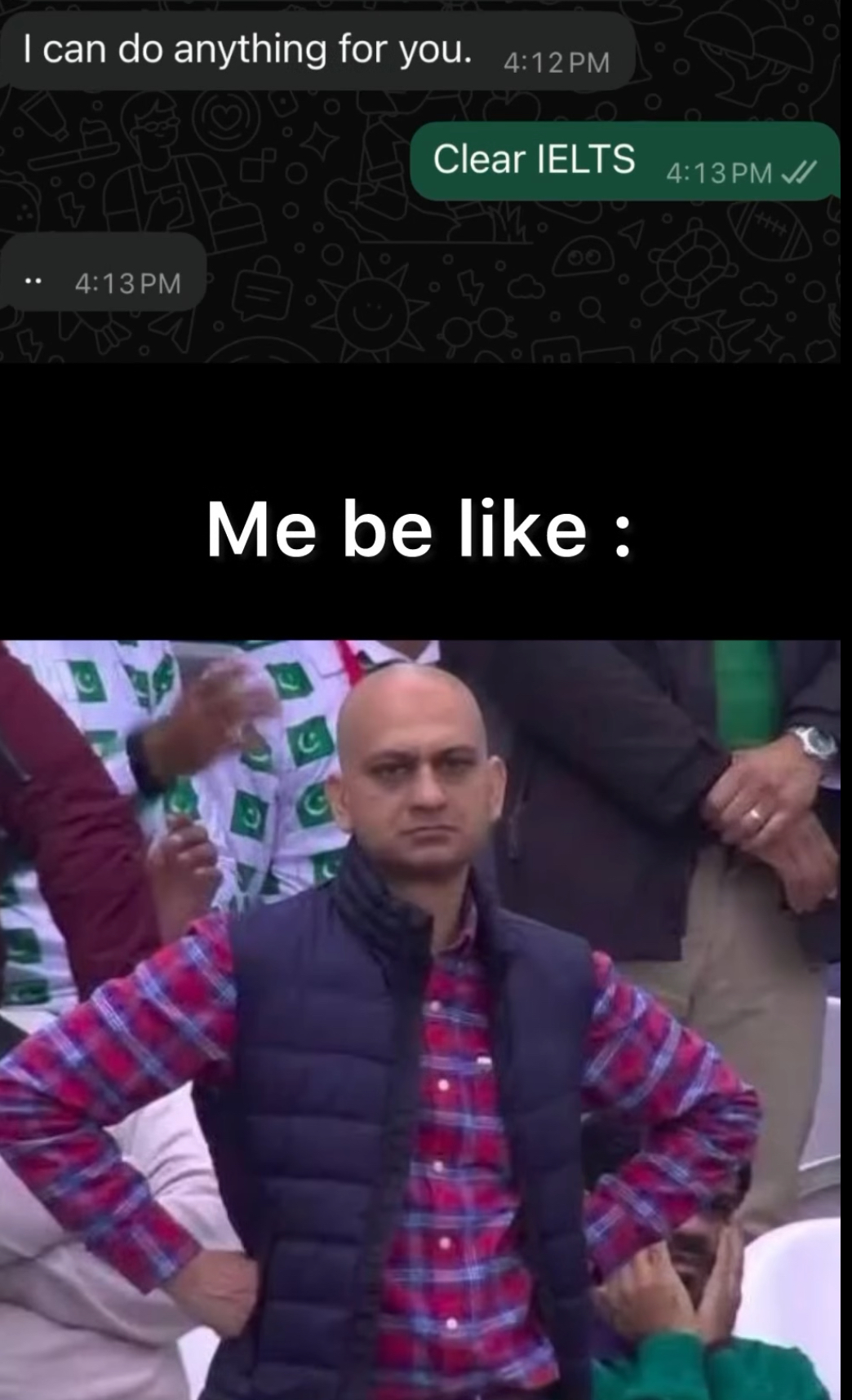
RADII Viewpoints on Gen Z dating in China, Hong Kong being used as free English lessons.
When your love language is “Band 8.0”. Image via Instagram.

Her brain froze. Instinctively, she pulled out her “IELTS Shield”—those memorized phrases every Chinese student studies just to pass English exams.

“Well, actually, on the one hand… but on the other hand…”

For the next hour, the dinner tasted like cardboard. Mia was too busy conjugating verbs in her head to taste the wine. When the bill was finally paid, she didn’t feel butterflies; she felt exhausted just like a student leaving the exam hall.

“My makeup was flawless, but my brain was fried,” she admits. “I treated a potential romance like a proficiency test. And honestly? I think I barely passed.”

Level 2: The “Safe” Middle Ground

After the trauma of the “IELTS Dinner,” the strategy shifted. If we couldn’t be fluent, we would be strategic.

So Mia checked her reflection. It was only 8 PM. Her makeup was still flawless, and her outfit was too good to waste on a failure.

For Mia, this meant grinding XP (experience points) on a safer mob: the ABC (American-born Chinese).
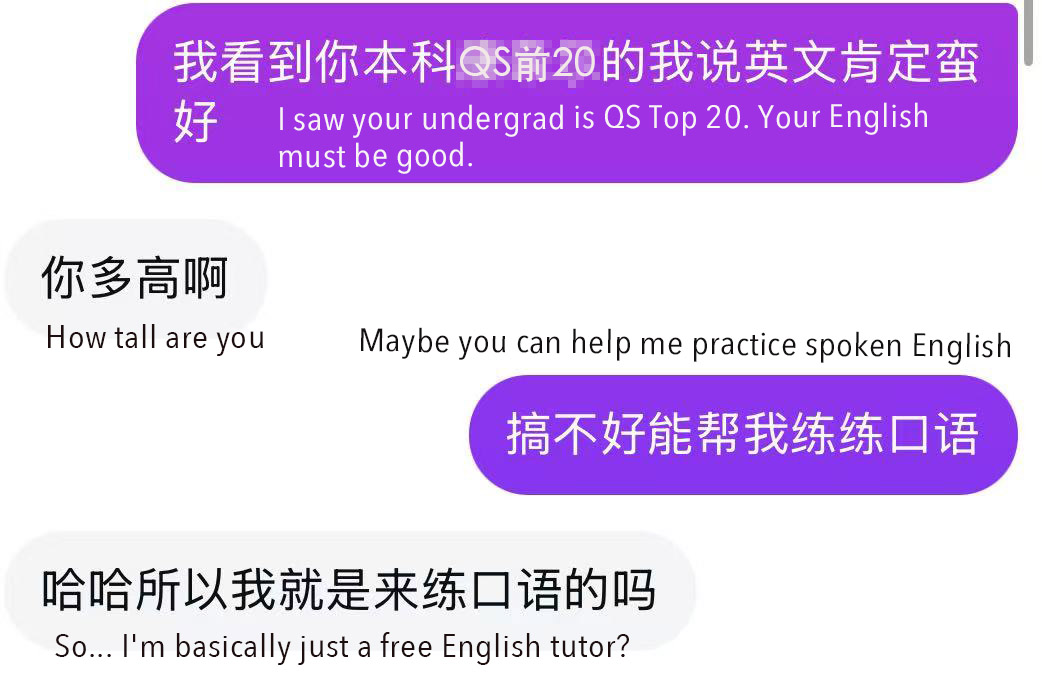
RADII Viewpoints on Gen Z dating in China, Hong Kong being used as free English lessons.
Image via by Mia.

They seemed like the perfect middle ground—the westernized, gym-sculpted physique she craved, but with a bilingual safety net. She matched with “Ivy League Boy” who ticked every box: top-tier degree, high-intellect elitism, and the quiet confidence of generational wealth.

He felt like a safer bet. But when they arrived at a trendy bar, Mia faced a new hurdle: an all-English menu and non-Chinese staff. Fresh from her earlier defeat, her confidence crumbled. She decided to “play dead” linguistically, pretending she couldn’t understand, simply to avoid the risk of being mocked by an elite speaker.

“I just let him take the stage,” she says.

And he did. He ordered for her fluently, joking with the bartenders, translating for her with a breezy confidence. Mia felt a mix of relief. She calls it “peacocking”—a male bird fanning his feathers to attract a mate. 

She enjoyed the experience. She liked the safety of a bilingual date. But as the drinks flowed and he got comfortable in his role as the “protector,” the cultural hierarchy reared its head.

“I can’t believe I finally got snagged by a Mainland chick,” he joked, swirling his cocktail.The label landed with a weird thud. ”Mainland chick.” As if it were a separate species.

RADII Viewpoints on Gen Z dating in China, Hong Kong being used as free English lessons.
That internal reaction when he implies dating you is “charity work.” Image via Google.

Mia mentally rolled her eyes: As opposed to what? An ABC? A white girl? By acting surprised that he fell for her, he wasn’t complimenting her uniqueness; he was revealing his own internal hierarchy, where “Mainland” usually sat a few rungs below his own Westernized status.

Mia didn’t bother calling out the condescension; she just realized he was walking, talking content. After ticking every box for Narcissistic Personality Disorder (NPD), he became the perfect case study for her term paper. “Most people would ghost him, but I saw a live lab rat,” she says. She kept the dates going—while he thought he was the player, he was actually just the homework.

While Mia turned her date into data, Vicky, a veteran dater in Shanghai, simply turns the tables.

For Gen Z girls, the app isn’t just a classroom; it’s a marketplace of expectations. And Vicky has no patience for bad deals.

She has grown tired of “tourists”—expats who swipe on local girls looking for a free tour guide to the Bund. “I’m not here to offer free services,” she says.

Her vetting process is ruthless. On one date, a guy suggested they split the bill after a mediocre meal. Now, in a Western context, this is normal. But in the specific cultural context of a first date in Shanghai, Vicky saw a red flag.

RADII Viewpoints on Gen Z dating in China, Hong Kong being used as free English lessons.
Image via Reddit.

“It wasn’t about the money,” Vicky explains. “It was the hypocrisy. He wanted the ‘traditional’ Asian girlfriend experience—someone attentive and compliant—without putting in the traditional courtship effort.”

Instead of taking the subway home as planned, Vicky called a taxi and left him on the sidewalk. She didn’t argue. She simply got away unscathed.

The Glitch

Anyway, the language barrier isn’t just a shield for us Chinese girls; it’s also a mirror for them.

While we navigate these cultural minefields, the men on the other side are experiencing their own version of “Lost in Translation.”Domenico, a 41-year-old artist, thinks the language barrier is a relief. He is currently chatting with a girl in Shenzhen who speaks almost no English—they mostly rely on Google Translate.

Domenico admits he used to be a “sweet talker,” using complex, poetic language to attract women. But with this girl, he is stripped of his weapons.

“I have to speak my truth in simple words,” he says.

RADII Viewpoints on Gen Z dating in China, Hong Kong being used as free English lessons.
In the film Tampopo, the pearl diver and the gastronome share a moment of intimacy that transcends language. Image via Tumblr/Tampopo (1985).

He references the Japanese film Tampopo, where characters connect through the physical act of shucking an oyster rather than dialogue. For him, the language barrier isn’t a bug; it’s a glitch that forces a kind of “accidental honesty.” He can’t manipulate her with fancy words because she simply wouldn’t understand them.

Boss Level: The Third Space

From another perspective, this glitch within the language barrier is actually building something new and beautiful.

Tali, a dating influencer, suggests that for a long-term relationship, English acts as a “filter,” which filters out the trauma of her native tongue and the East Asian repression.It’s always hard for her to quarrel with her non-native English-speaking partner. She mirrors her parents’ fighting style—fast, hysterical, and hurtful. But in English, she can’t be that fast even if she wants to. The difficulty of the language forces her to slow down, to be logical, building a buffer zone against toxic patterns.

RADII Viewpoints on Gen Z dating in China, Hong Kong being used as free English lessons.
Image via Reddit.

Also, she recounts a moment with her boyfriend where she bluntly told him: “I would like to mate with you.” She laughs, “I would never say that in Chinese. It’s too shameful. But in English, the words just came out.”

This is the “Third Space”—a relationship built not on perfect grammar, but on a new, shared language that belongs to neither person fully.

Game Over: The Reward

So, is dating in China just a free English lesson?

Maybe at first. We start with utilitarian goals—to hack the system, to find a tutor, to touch the hem of a cosmopolitan lifestyle. We enter the game feeling inferior, armed with memorized phrases.

But along the way, the game changes.

We find that the second language offers us a mask, and behind that mask, we are braver. We learn to analyze narcissists like Mia, to set boundaries like Vicky, and to express desire without shame like Tali.

We might not find true love in the chaos of Tinder. We might end up with some awkward silences and split bills. But at least now, when we get our hearts broken, we can curse in a second language.

Cover image via Instagram/Timdurg.

NEWSLETTER

Get weekly top picks and exclusive, newsletter only content delivered straight to you inbox.

NEWSLETTER

Get weekly top picks and exclusive, newsletter only content delivered straight to you inbox.

RADII NEWSLETTER

Get weekly top picks and exclusive, newsletter only content delivered straight to you inbox

Feature image of Swipe Right for Fluency: Is Dating in China Just a Free English Lesson?

Swipe Right for Fluency: Is Dating in China Just a Free English Lesson?

6 mins read

From taking dates as IELTS speaking tests to "study-buddying" with ABCs, Gen Z girls are hacking the language of intimacy. But in this game of love and linguistics, who is playing whom?

It’s a Friday night on Peel Street, the pulsating aorta of Hong Kong’s nightlife. I am squeezed between a loud Italian man and a British woman, nodding now and then as they dissect their dating disasters.

To an outsider, I look engaged. Inside, my brain is buffering. I only catch 30% of what they are saying, smiling vacantly like an NPC in a video game.

But I’m not just here for the beer. I, like many Gen Z girls from the mainland living in this Tower of Babel, am wondering: am I looking for love? Or am I just subconsciously trying to “level up” my cosmopolitan vibe?

Across China’s first-tier cities, dating apps like Tinder and Bumble seem to have morphed into something else: Duolingo Pro, but with better cocktails and higher emotional stakes.

Here is what happens when the quest for romance collides with the quest for proficiency.

Level 1: The Panic of the “Oral Exam”

For Mia, a master’s student in Hong Kong, the first boss battle was a white expat she met at a networking event. He was polite, professional—the perfect “native speaker” practice partner.

But when they sat down for a one-on-one dinner, the romance evaporated.

“I couldn’t bear this awkward silence,” Mia confesses. “Then he asked me, ‘How does life in Hong Kong compare to your expectations?’ It sounded exactly like an examiner’s prompt.”

RADII Viewpoints on Gen Z dating in China, Hong Kong being used as free English lessons.
When your love language is “Band 8.0”. Image via Instagram.

Her brain froze. Instinctively, she pulled out her “IELTS Shield”—those memorized phrases every Chinese student studies just to pass English exams.

“Well, actually, on the one hand… but on the other hand…”

For the next hour, the dinner tasted like cardboard. Mia was too busy conjugating verbs in her head to taste the wine. When the bill was finally paid, she didn’t feel butterflies; she felt exhausted just like a student leaving the exam hall.

“My makeup was flawless, but my brain was fried,” she admits. “I treated a potential romance like a proficiency test. And honestly? I think I barely passed.”

Level 2: The “Safe” Middle Ground

After the trauma of the “IELTS Dinner,” the strategy shifted. If we couldn’t be fluent, we would be strategic.

So Mia checked her reflection. It was only 8 PM. Her makeup was still flawless, and her outfit was too good to waste on a failure.

For Mia, this meant grinding XP (experience points) on a safer mob: the ABC (American-born Chinese).

RADII Viewpoints on Gen Z dating in China, Hong Kong being used as free English lessons.
Image via by Mia.

They seemed like the perfect middle ground—the westernized, gym-sculpted physique she craved, but with a bilingual safety net. She matched with “Ivy League Boy” who ticked every box: top-tier degree, high-intellect elitism, and the quiet confidence of generational wealth.

He felt like a safer bet. But when they arrived at a trendy bar, Mia faced a new hurdle: an all-English menu and non-Chinese staff. Fresh from her earlier defeat, her confidence crumbled. She decided to “play dead” linguistically, pretending she couldn’t understand, simply to avoid the risk of being mocked by an elite speaker.

“I just let him take the stage,” she says.

And he did. He ordered for her fluently, joking with the bartenders, translating for her with a breezy confidence. Mia felt a mix of relief. She calls it “peacocking”—a male bird fanning his feathers to attract a mate. 

She enjoyed the experience. She liked the safety of a bilingual date. But as the drinks flowed and he got comfortable in his role as the “protector,” the cultural hierarchy reared its head.

“I can’t believe I finally got snagged by a Mainland chick,” he joked, swirling his cocktail.The label landed with a weird thud. ”Mainland chick.” As if it were a separate species.

RADII Viewpoints on Gen Z dating in China, Hong Kong being used as free English lessons.
That internal reaction when he implies dating you is “charity work.” Image via Google.

Mia mentally rolled her eyes: As opposed to what? An ABC? A white girl? By acting surprised that he fell for her, he wasn’t complimenting her uniqueness; he was revealing his own internal hierarchy, where “Mainland” usually sat a few rungs below his own Westernized status.

Mia didn’t bother calling out the condescension; she just realized he was walking, talking content. After ticking every box for Narcissistic Personality Disorder (NPD), he became the perfect case study for her term paper. “Most people would ghost him, but I saw a live lab rat,” she says. She kept the dates going—while he thought he was the player, he was actually just the homework.

While Mia turned her date into data, Vicky, a veteran dater in Shanghai, simply turns the tables.

For Gen Z girls, the app isn’t just a classroom; it’s a marketplace of expectations. And Vicky has no patience for bad deals.

She has grown tired of “tourists”—expats who swipe on local girls looking for a free tour guide to the Bund. “I’m not here to offer free services,” she says.

Her vetting process is ruthless. On one date, a guy suggested they split the bill after a mediocre meal. Now, in a Western context, this is normal. But in the specific cultural context of a first date in Shanghai, Vicky saw a red flag.

RADII Viewpoints on Gen Z dating in China, Hong Kong being used as free English lessons.
Image via Reddit.

“It wasn’t about the money,” Vicky explains. “It was the hypocrisy. He wanted the ‘traditional’ Asian girlfriend experience—someone attentive and compliant—without putting in the traditional courtship effort.”

Instead of taking the subway home as planned, Vicky called a taxi and left him on the sidewalk. She didn’t argue. She simply got away unscathed.

The Glitch

Anyway, the language barrier isn’t just a shield for us Chinese girls; it’s also a mirror for them.

While we navigate these cultural minefields, the men on the other side are experiencing their own version of “Lost in Translation.”Domenico, a 41-year-old artist, thinks the language barrier is a relief. He is currently chatting with a girl in Shenzhen who speaks almost no English—they mostly rely on Google Translate.

Domenico admits he used to be a “sweet talker,” using complex, poetic language to attract women. But with this girl, he is stripped of his weapons.

“I have to speak my truth in simple words,” he says.

RADII Viewpoints on Gen Z dating in China, Hong Kong being used as free English lessons.
In the film Tampopo, the pearl diver and the gastronome share a moment of intimacy that transcends language. Image via Tumblr/Tampopo (1985).

He references the Japanese film Tampopo, where characters connect through the physical act of shucking an oyster rather than dialogue. For him, the language barrier isn’t a bug; it’s a glitch that forces a kind of “accidental honesty.” He can’t manipulate her with fancy words because she simply wouldn’t understand them.

Boss Level: The Third Space

From another perspective, this glitch within the language barrier is actually building something new and beautiful.

Tali, a dating influencer, suggests that for a long-term relationship, English acts as a “filter,” which filters out the trauma of her native tongue and the East Asian repression.It’s always hard for her to quarrel with her non-native English-speaking partner. She mirrors her parents’ fighting style—fast, hysterical, and hurtful. But in English, she can’t be that fast even if she wants to. The difficulty of the language forces her to slow down, to be logical, building a buffer zone against toxic patterns.

RADII Viewpoints on Gen Z dating in China, Hong Kong being used as free English lessons.
Image via Reddit.

Also, she recounts a moment with her boyfriend where she bluntly told him: “I would like to mate with you.” She laughs, “I would never say that in Chinese. It’s too shameful. But in English, the words just came out.”

This is the “Third Space”—a relationship built not on perfect grammar, but on a new, shared language that belongs to neither person fully.

Game Over: The Reward

So, is dating in China just a free English lesson?

Maybe at first. We start with utilitarian goals—to hack the system, to find a tutor, to touch the hem of a cosmopolitan lifestyle. We enter the game feeling inferior, armed with memorized phrases.

But along the way, the game changes.

We find that the second language offers us a mask, and behind that mask, we are braver. We learn to analyze narcissists like Mia, to set boundaries like Vicky, and to express desire without shame like Tali.

We might not find true love in the chaos of Tinder. We might end up with some awkward silences and split bills. But at least now, when we get our hearts broken, we can curse in a second language.

Cover image via Instagram/Timdurg.

NEWSLETTER

Get weekly top picks and exclusive, newsletter only content delivered straight to you inbox.

RADII NEWSLETTER

Get weekly top picks and exclusive, newsletter only content delivered straight to you inbox

RELATED POSTS

Feature image of Swipe Right for Fluency: Is Dating in China Just a Free English Lesson?

Swipe Right for Fluency: Is Dating in China Just a Free English Lesson?

6 mins read

6 mins read

Feature image of Swipe Right for Fluency: Is Dating in China Just a Free English Lesson?
From taking dates as IELTS speaking tests to "study-buddying" with ABCs, Gen Z girls are hacking the language of intimacy. But in this game of love and linguistics, who is playing whom?

It’s a Friday night on Peel Street, the pulsating aorta of Hong Kong’s nightlife. I am squeezed between a loud Italian man and a British woman, nodding now and then as they dissect their dating disasters.

To an outsider, I look engaged. Inside, my brain is buffering. I only catch 30% of what they are saying, smiling vacantly like an NPC in a video game.

But I’m not just here for the beer. I, like many Gen Z girls from the mainland living in this Tower of Babel, am wondering: am I looking for love? Or am I just subconsciously trying to “level up” my cosmopolitan vibe?

Across China’s first-tier cities, dating apps like Tinder and Bumble seem to have morphed into something else: Duolingo Pro, but with better cocktails and higher emotional stakes.

Here is what happens when the quest for romance collides with the quest for proficiency.

Level 1: The Panic of the “Oral Exam”

For Mia, a master’s student in Hong Kong, the first boss battle was a white expat she met at a networking event. He was polite, professional—the perfect “native speaker” practice partner.

But when they sat down for a one-on-one dinner, the romance evaporated.

“I couldn’t bear this awkward silence,” Mia confesses. “Then he asked me, ‘How does life in Hong Kong compare to your expectations?’ It sounded exactly like an examiner’s prompt.”

RADII Viewpoints on Gen Z dating in China, Hong Kong being used as free English lessons.
When your love language is “Band 8.0”. Image via Instagram.

Her brain froze. Instinctively, she pulled out her “IELTS Shield”—those memorized phrases every Chinese student studies just to pass English exams.

“Well, actually, on the one hand… but on the other hand…”

For the next hour, the dinner tasted like cardboard. Mia was too busy conjugating verbs in her head to taste the wine. When the bill was finally paid, she didn’t feel butterflies; she felt exhausted just like a student leaving the exam hall.

“My makeup was flawless, but my brain was fried,” she admits. “I treated a potential romance like a proficiency test. And honestly? I think I barely passed.”

Level 2: The “Safe” Middle Ground

After the trauma of the “IELTS Dinner,” the strategy shifted. If we couldn’t be fluent, we would be strategic.

So Mia checked her reflection. It was only 8 PM. Her makeup was still flawless, and her outfit was too good to waste on a failure.

For Mia, this meant grinding XP (experience points) on a safer mob: the ABC (American-born Chinese).

RADII Viewpoints on Gen Z dating in China, Hong Kong being used as free English lessons.
Image via by Mia.

They seemed like the perfect middle ground—the westernized, gym-sculpted physique she craved, but with a bilingual safety net. She matched with “Ivy League Boy” who ticked every box: top-tier degree, high-intellect elitism, and the quiet confidence of generational wealth.

He felt like a safer bet. But when they arrived at a trendy bar, Mia faced a new hurdle: an all-English menu and non-Chinese staff. Fresh from her earlier defeat, her confidence crumbled. She decided to “play dead” linguistically, pretending she couldn’t understand, simply to avoid the risk of being mocked by an elite speaker.

“I just let him take the stage,” she says.

And he did. He ordered for her fluently, joking with the bartenders, translating for her with a breezy confidence. Mia felt a mix of relief. She calls it “peacocking”—a male bird fanning his feathers to attract a mate. 

She enjoyed the experience. She liked the safety of a bilingual date. But as the drinks flowed and he got comfortable in his role as the “protector,” the cultural hierarchy reared its head.

“I can’t believe I finally got snagged by a Mainland chick,” he joked, swirling his cocktail.The label landed with a weird thud. ”Mainland chick.” As if it were a separate species.

RADII Viewpoints on Gen Z dating in China, Hong Kong being used as free English lessons.
That internal reaction when he implies dating you is “charity work.” Image via Google.

Mia mentally rolled her eyes: As opposed to what? An ABC? A white girl? By acting surprised that he fell for her, he wasn’t complimenting her uniqueness; he was revealing his own internal hierarchy, where “Mainland” usually sat a few rungs below his own Westernized status.

Mia didn’t bother calling out the condescension; she just realized he was walking, talking content. After ticking every box for Narcissistic Personality Disorder (NPD), he became the perfect case study for her term paper. “Most people would ghost him, but I saw a live lab rat,” she says. She kept the dates going—while he thought he was the player, he was actually just the homework.

While Mia turned her date into data, Vicky, a veteran dater in Shanghai, simply turns the tables.

For Gen Z girls, the app isn’t just a classroom; it’s a marketplace of expectations. And Vicky has no patience for bad deals.

She has grown tired of “tourists”—expats who swipe on local girls looking for a free tour guide to the Bund. “I’m not here to offer free services,” she says.

Her vetting process is ruthless. On one date, a guy suggested they split the bill after a mediocre meal. Now, in a Western context, this is normal. But in the specific cultural context of a first date in Shanghai, Vicky saw a red flag.

RADII Viewpoints on Gen Z dating in China, Hong Kong being used as free English lessons.
Image via Reddit.

“It wasn’t about the money,” Vicky explains. “It was the hypocrisy. He wanted the ‘traditional’ Asian girlfriend experience—someone attentive and compliant—without putting in the traditional courtship effort.”

Instead of taking the subway home as planned, Vicky called a taxi and left him on the sidewalk. She didn’t argue. She simply got away unscathed.

The Glitch

Anyway, the language barrier isn’t just a shield for us Chinese girls; it’s also a mirror for them.

While we navigate these cultural minefields, the men on the other side are experiencing their own version of “Lost in Translation.”Domenico, a 41-year-old artist, thinks the language barrier is a relief. He is currently chatting with a girl in Shenzhen who speaks almost no English—they mostly rely on Google Translate.

Domenico admits he used to be a “sweet talker,” using complex, poetic language to attract women. But with this girl, he is stripped of his weapons.

“I have to speak my truth in simple words,” he says.

RADII Viewpoints on Gen Z dating in China, Hong Kong being used as free English lessons.
In the film Tampopo, the pearl diver and the gastronome share a moment of intimacy that transcends language. Image via Tumblr/Tampopo (1985).

He references the Japanese film Tampopo, where characters connect through the physical act of shucking an oyster rather than dialogue. For him, the language barrier isn’t a bug; it’s a glitch that forces a kind of “accidental honesty.” He can’t manipulate her with fancy words because she simply wouldn’t understand them.

Boss Level: The Third Space

From another perspective, this glitch within the language barrier is actually building something new and beautiful.

Tali, a dating influencer, suggests that for a long-term relationship, English acts as a “filter,” which filters out the trauma of her native tongue and the East Asian repression.It’s always hard for her to quarrel with her non-native English-speaking partner. She mirrors her parents’ fighting style—fast, hysterical, and hurtful. But in English, she can’t be that fast even if she wants to. The difficulty of the language forces her to slow down, to be logical, building a buffer zone against toxic patterns.

RADII Viewpoints on Gen Z dating in China, Hong Kong being used as free English lessons.
Image via Reddit.

Also, she recounts a moment with her boyfriend where she bluntly told him: “I would like to mate with you.” She laughs, “I would never say that in Chinese. It’s too shameful. But in English, the words just came out.”

This is the “Third Space”—a relationship built not on perfect grammar, but on a new, shared language that belongs to neither person fully.

Game Over: The Reward

So, is dating in China just a free English lesson?

Maybe at first. We start with utilitarian goals—to hack the system, to find a tutor, to touch the hem of a cosmopolitan lifestyle. We enter the game feeling inferior, armed with memorized phrases.

But along the way, the game changes.

We find that the second language offers us a mask, and behind that mask, we are braver. We learn to analyze narcissists like Mia, to set boundaries like Vicky, and to express desire without shame like Tali.

We might not find true love in the chaos of Tinder. We might end up with some awkward silences and split bills. But at least now, when we get our hearts broken, we can curse in a second language.

Cover image via Instagram/Timdurg.

NEWSLETTER

Get weekly top picks and exclusive, newsletter only content delivered straight to you inbox.

NEWSLETTER

Get weekly top picks and exclusive, newsletter only content delivered straight to you inbox.

RADII NEWSLETTER

Get weekly top picks and exclusive, newsletter only content delivered straight to you inbox

Feature image of Swipe Right for Fluency: Is Dating in China Just a Free English Lesson?

Swipe Right for Fluency: Is Dating in China Just a Free English Lesson?

6 mins read

From taking dates as IELTS speaking tests to "study-buddying" with ABCs, Gen Z girls are hacking the language of intimacy. But in this game of love and linguistics, who is playing whom?

It’s a Friday night on Peel Street, the pulsating aorta of Hong Kong’s nightlife. I am squeezed between a loud Italian man and a British woman, nodding now and then as they dissect their dating disasters.

To an outsider, I look engaged. Inside, my brain is buffering. I only catch 30% of what they are saying, smiling vacantly like an NPC in a video game.

But I’m not just here for the beer. I, like many Gen Z girls from the mainland living in this Tower of Babel, am wondering: am I looking for love? Or am I just subconsciously trying to “level up” my cosmopolitan vibe?

Across China’s first-tier cities, dating apps like Tinder and Bumble seem to have morphed into something else: Duolingo Pro, but with better cocktails and higher emotional stakes.

Here is what happens when the quest for romance collides with the quest for proficiency.

Level 1: The Panic of the “Oral Exam”

For Mia, a master’s student in Hong Kong, the first boss battle was a white expat she met at a networking event. He was polite, professional—the perfect “native speaker” practice partner.

But when they sat down for a one-on-one dinner, the romance evaporated.

“I couldn’t bear this awkward silence,” Mia confesses. “Then he asked me, ‘How does life in Hong Kong compare to your expectations?’ It sounded exactly like an examiner’s prompt.”

RADII Viewpoints on Gen Z dating in China, Hong Kong being used as free English lessons.
When your love language is “Band 8.0”. Image via Instagram.

Her brain froze. Instinctively, she pulled out her “IELTS Shield”—those memorized phrases every Chinese student studies just to pass English exams.

“Well, actually, on the one hand… but on the other hand…”

For the next hour, the dinner tasted like cardboard. Mia was too busy conjugating verbs in her head to taste the wine. When the bill was finally paid, she didn’t feel butterflies; she felt exhausted just like a student leaving the exam hall.

“My makeup was flawless, but my brain was fried,” she admits. “I treated a potential romance like a proficiency test. And honestly? I think I barely passed.”

Level 2: The “Safe” Middle Ground

After the trauma of the “IELTS Dinner,” the strategy shifted. If we couldn’t be fluent, we would be strategic.

So Mia checked her reflection. It was only 8 PM. Her makeup was still flawless, and her outfit was too good to waste on a failure.

For Mia, this meant grinding XP (experience points) on a safer mob: the ABC (American-born Chinese).

RADII Viewpoints on Gen Z dating in China, Hong Kong being used as free English lessons.
Image via by Mia.

They seemed like the perfect middle ground—the westernized, gym-sculpted physique she craved, but with a bilingual safety net. She matched with “Ivy League Boy” who ticked every box: top-tier degree, high-intellect elitism, and the quiet confidence of generational wealth.

He felt like a safer bet. But when they arrived at a trendy bar, Mia faced a new hurdle: an all-English menu and non-Chinese staff. Fresh from her earlier defeat, her confidence crumbled. She decided to “play dead” linguistically, pretending she couldn’t understand, simply to avoid the risk of being mocked by an elite speaker.

“I just let him take the stage,” she says.

And he did. He ordered for her fluently, joking with the bartenders, translating for her with a breezy confidence. Mia felt a mix of relief. She calls it “peacocking”—a male bird fanning his feathers to attract a mate. 

She enjoyed the experience. She liked the safety of a bilingual date. But as the drinks flowed and he got comfortable in his role as the “protector,” the cultural hierarchy reared its head.

“I can’t believe I finally got snagged by a Mainland chick,” he joked, swirling his cocktail.The label landed with a weird thud. ”Mainland chick.” As if it were a separate species.

RADII Viewpoints on Gen Z dating in China, Hong Kong being used as free English lessons.
That internal reaction when he implies dating you is “charity work.” Image via Google.

Mia mentally rolled her eyes: As opposed to what? An ABC? A white girl? By acting surprised that he fell for her, he wasn’t complimenting her uniqueness; he was revealing his own internal hierarchy, where “Mainland” usually sat a few rungs below his own Westernized status.

Mia didn’t bother calling out the condescension; she just realized he was walking, talking content. After ticking every box for Narcissistic Personality Disorder (NPD), he became the perfect case study for her term paper. “Most people would ghost him, but I saw a live lab rat,” she says. She kept the dates going—while he thought he was the player, he was actually just the homework.

While Mia turned her date into data, Vicky, a veteran dater in Shanghai, simply turns the tables.

For Gen Z girls, the app isn’t just a classroom; it’s a marketplace of expectations. And Vicky has no patience for bad deals.

She has grown tired of “tourists”—expats who swipe on local girls looking for a free tour guide to the Bund. “I’m not here to offer free services,” she says.

Her vetting process is ruthless. On one date, a guy suggested they split the bill after a mediocre meal. Now, in a Western context, this is normal. But in the specific cultural context of a first date in Shanghai, Vicky saw a red flag.

RADII Viewpoints on Gen Z dating in China, Hong Kong being used as free English lessons.
Image via Reddit.

“It wasn’t about the money,” Vicky explains. “It was the hypocrisy. He wanted the ‘traditional’ Asian girlfriend experience—someone attentive and compliant—without putting in the traditional courtship effort.”

Instead of taking the subway home as planned, Vicky called a taxi and left him on the sidewalk. She didn’t argue. She simply got away unscathed.

The Glitch

Anyway, the language barrier isn’t just a shield for us Chinese girls; it’s also a mirror for them.

While we navigate these cultural minefields, the men on the other side are experiencing their own version of “Lost in Translation.”Domenico, a 41-year-old artist, thinks the language barrier is a relief. He is currently chatting with a girl in Shenzhen who speaks almost no English—they mostly rely on Google Translate.

Domenico admits he used to be a “sweet talker,” using complex, poetic language to attract women. But with this girl, he is stripped of his weapons.

“I have to speak my truth in simple words,” he says.

RADII Viewpoints on Gen Z dating in China, Hong Kong being used as free English lessons.
In the film Tampopo, the pearl diver and the gastronome share a moment of intimacy that transcends language. Image via Tumblr/Tampopo (1985).

He references the Japanese film Tampopo, where characters connect through the physical act of shucking an oyster rather than dialogue. For him, the language barrier isn’t a bug; it’s a glitch that forces a kind of “accidental honesty.” He can’t manipulate her with fancy words because she simply wouldn’t understand them.

Boss Level: The Third Space

From another perspective, this glitch within the language barrier is actually building something new and beautiful.

Tali, a dating influencer, suggests that for a long-term relationship, English acts as a “filter,” which filters out the trauma of her native tongue and the East Asian repression.It’s always hard for her to quarrel with her non-native English-speaking partner. She mirrors her parents’ fighting style—fast, hysterical, and hurtful. But in English, she can’t be that fast even if she wants to. The difficulty of the language forces her to slow down, to be logical, building a buffer zone against toxic patterns.

RADII Viewpoints on Gen Z dating in China, Hong Kong being used as free English lessons.
Image via Reddit.

Also, she recounts a moment with her boyfriend where she bluntly told him: “I would like to mate with you.” She laughs, “I would never say that in Chinese. It’s too shameful. But in English, the words just came out.”

This is the “Third Space”—a relationship built not on perfect grammar, but on a new, shared language that belongs to neither person fully.

Game Over: The Reward

So, is dating in China just a free English lesson?

Maybe at first. We start with utilitarian goals—to hack the system, to find a tutor, to touch the hem of a cosmopolitan lifestyle. We enter the game feeling inferior, armed with memorized phrases.

But along the way, the game changes.

We find that the second language offers us a mask, and behind that mask, we are braver. We learn to analyze narcissists like Mia, to set boundaries like Vicky, and to express desire without shame like Tali.

We might not find true love in the chaos of Tinder. We might end up with some awkward silences and split bills. But at least now, when we get our hearts broken, we can curse in a second language.

Cover image via Instagram/Timdurg.

NEWSLETTER

Get weekly top picks and exclusive, newsletter only content delivered straight to you inbox.

RADII NEWSLETTER

Get weekly top picks and exclusive, newsletter only content delivered straight to you inbox

RELATED POSTS

NEWSLETTER​

Get weekly top picks and exclusive, newsletter only content delivered straight to you inbox

RADII Newsletter Pop Up small banner

NEWSLETTER

Get weekly top picks and exclusive, newsletter only content delivered straight to you inbox.

Link Copied!

Share

Feature image of Swipe Right for Fluency: Is Dating in China Just a Free English Lesson?

Swipe Right for Fluency: Is Dating in China Just a Free English Lesson?

From taking dates as IELTS speaking tests to "study-buddying" with ABCs, Gen Z girls are hacking the language of intimacy. But in this game of love and linguistics, who is playing whom?

PULSE

Tap into the latest in music, fashion, art, design, entertainment, pop culture, celebrity news, and contemporary culture

DISCOVER

Embark on a journey through food, travel, wellness, heritage, traditional culture, and lifestyle

STYLE

An insider’s look at the intersection of fashion, art, and design

FEAST

Titillate your taste buds with coverage of the best food and drink trends from China and beyond.

FUTURE

Explore the cutting edge in tech, AI, gadgets, gaming, and innovative tech-related products

FEAST

Titillate your taste buds with coverage of the best food and drink trends from China and beyond

STYLE

An insider’s look at the intersection of fashion, art, and design

PULSE

Unpacking Chinese youth culture through coverage of nightlife, film, sports, celebrities, and the hottest new music